About Engonopoulos
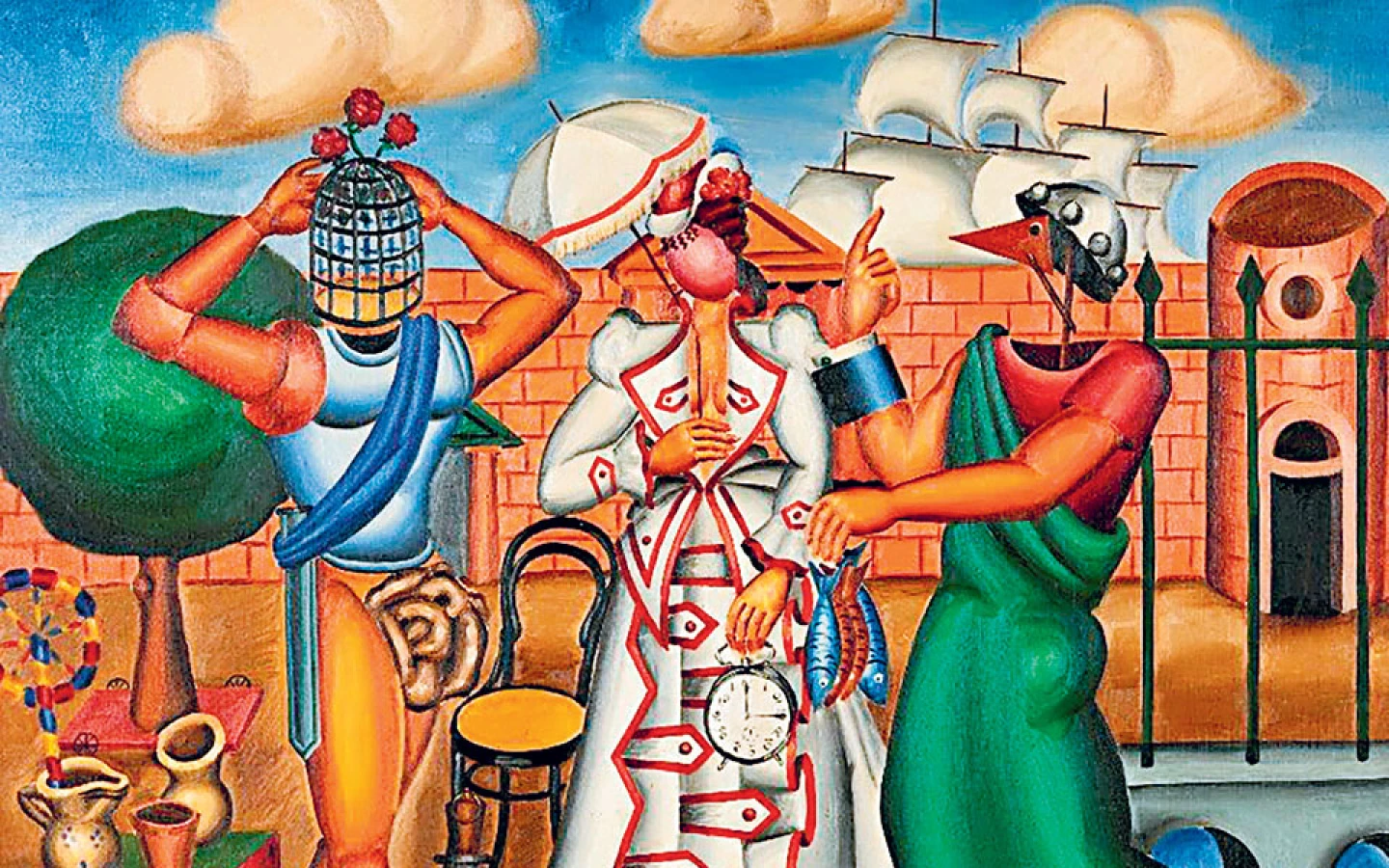
Fascinated by De Chirico and a fan of Dalí, he largely focused on Greek mythology, the Byzantine tradition, and the country’s modern history. Despite being criticized, and even ridiculed back then, Engonopoulos remained true to his style that set him apart as one of Greece’s most famous painters. His world was a universe of painting with imaginary heroes from mythology and literature, history and poetry, with references to Hermes, Io, Hercules, Eurydice, Orpheus, Odysseus and Calypso. By uniting the past with the present, he showcased the power of surrealist expression through painting, using pure colours and strong drawing skills. Engonopoulos was a deeply spiritual person who tried to express the universality of Hellenism through his work. “With art we can face the incoherence of life. Art can alleviate our life, the path to death,” he was often quoted as saying.
Early Life
Born on October 21, 1907, in Athens, he attended school in Paris and spent much of his childhood there. When he returned to Athens, Engonopoulos worked a number of jobs, including being a translator, bank teller, and secretary at the University of Athens. In 1930, he began working as a designer in the Urban Planning Department of the Greek Ministry of Public Works. Unsatisfied with his career and hoping to pursue art, Engonopoulos enrolled at the Athens School of Fine Arts in 1932, which was a vibrant period for the school, when many great Greek artists were studying and teaching there.
Generation of the 30s
He was a member of the Generation of the 30s, a group of Greek writers, poets, artists, intellectuals, critics, and scholars who made their debut in the 1930s and introduced modernism to Greek art and literature. The previous Medieval and post-Byzantine Greek eras, which glorified religion, Jesus, and the certainty of Enlightenment thinking, were rejected by modernism. The most notable member among the Generation of the ‘30s is Giorgos Seferis, a Greek poet who instigated the turning point into modernity with surrealism in his poetry. During this time, Engolopoulos met important artists, poet Andreas Embirikos, and painters, such as Yannis Tsarouchis, Giorgo de Chirico, and Yannis Moralis.