
03.09.2026
Buying an Off-Plan House in Greece from Abroad Explained
“How can I buy a house in Greece that is not built yet from abroad?”
That’s a very common question we receive from clients interested in buying an off-plan house.

Purchase Tips
11.04.2025
Is it worth buying a home in Greece, and what sort of return might you actually see? These are natural questions, because a property abroad is a long-term commitment. Rather than answer in the abstract, this article follows one real purchase from start to finish. We look at what it cost to buy, what it earned in rent, and what happened when the owners sold, so you can see how the figures come together at each stage. The numbers come from the anonymised records of a client who bought through Elxis. They describe one property, not an average. Treat them as an illustration rather than a forecast, since your own results will depend on location, timing, and the market at the time.
There are two main ways to earn a return on a home in Greece.
If a home gains value between the year you buy it and the year you sell it, you make a profit on the difference. To get a good price, it helps to know what your home is worth and to negotiate well, which is where an experienced local agent earns their keep. As one illustration from our own listings, a newly built villa in the south of Rethymno, Crete, with around 80 square metres of living space, three bedrooms, two bathrooms, and a pool, was offered in 2024 at €327,000. Comparable properties in the same area were offered lower in the preceding years. Figures like these reflect specific homes in a specific area, not the market as a whole, so they are best read as examples rather than a trend you can count on.
The other way to earn is to rent the home out when you are not using it. As a rough guide, a villa with 50 to 80 square metres of living space, modern fittings, a terrace, a sea view, and a pool tends to rent for around 80 to 140 euros per night per bedroom. A larger villa, with 120 to 150 square metres of living space and a generous outdoor area, tends to rent for around 180 to 240 euros per night per bedroom. Rental management companies typically charge between 10 and 30 percent commission, depending on what is included, such as housekeeping, pool and garden care, guest communication, marketing, and tax registration. Rental income varies a great deal by region. Homes on Santorini or Mykonos, or right on the beach, command higher nightly rates than the ranges above. The main factors that set the price are the sea view, the distance to tourist sites and the airport, walkability, the age of the building, and the outdoor and pool area.
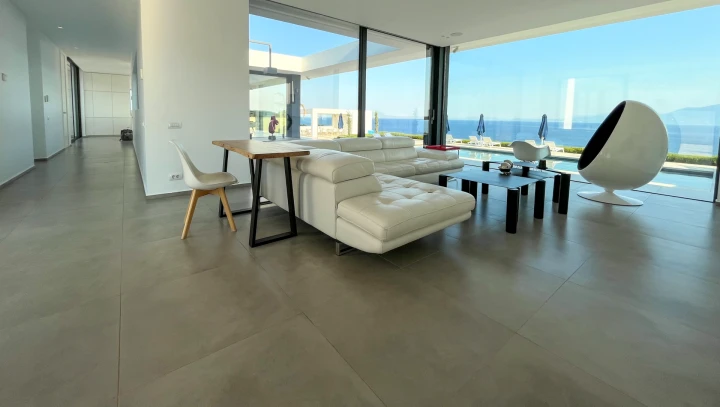
For this example, assume a home with the following features:
Plot size: 680 square metres
House size: 145 square metres
Layout: 3 bedrooms, 3 bathrooms
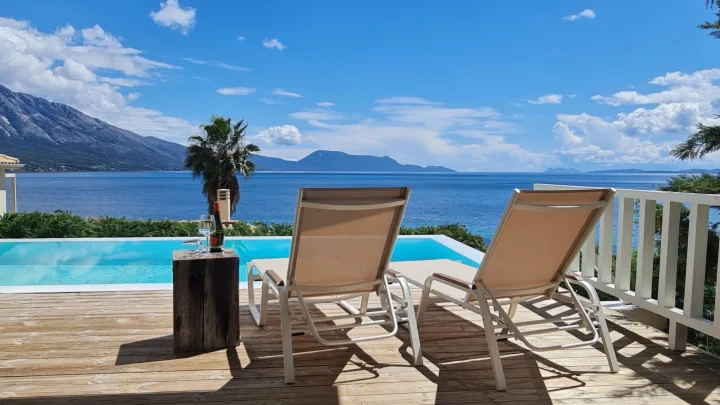
Features: private heated pool, sea view, landscaped garden, outdoor kitchen
Distance from the sea: 3.5 km
Year of purchase: 2019, off-plan
Status: fully furnished
The data comes from the anonymised records of a homeowner who bought through Elxis. It is not representative of all homes in Greece, and it does not reflect market averages.
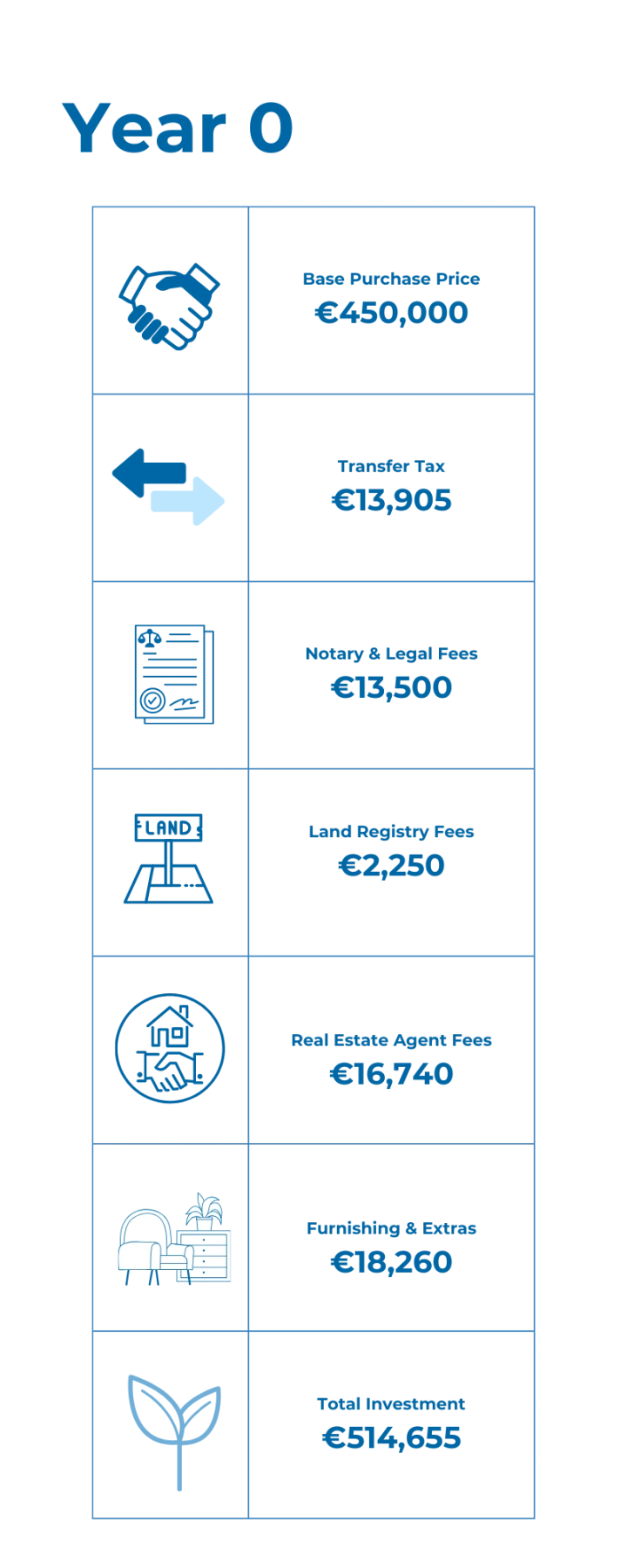
In Year 0, the total investment came to €514,655. This was made up of a base purchase price of €450,000 plus the costs of buying and furnishing the home:
Base purchase price: €450,000
Transfer tax (3.09%*): €13,905
Notary and legal fees (including VAT): €13,500
Land registry fees (around 0.5%): €2,250
Real estate agent commission (3% + VAT): €16,740
Furnishing and extras: €18,260
*Important update: The Greek Prime Minister, Kyriakos Mitsotakis, has announced that the property transfer tax for purchases by non-EU citizens is set to rise to 15%, with the change expected to apply from 1 January 2027. The implementing legislation has not yet been published, so the final scope, including how it may treat plots of land and commercial property, is not yet confirmed.
As a working figure, the costs of buying a home in Greece come to around 10 percent of the purchase price once an agent and a lawyer are involved, as in this example. Here is what sits inside that figure.
Transfer tax. This is paid by the buyer and comes to 3.09%* of the property's value, based on the commercial value or the taxable value, whichever is higher. It is paid before the deed is signed, because the notary attaches proof of payment to the deed. New-build properties can fall under VAT rules instead of transfer tax, though VAT on new builds is currently suspended, so transfer tax often applies.
Notary fees. The notary prepares the deed, which is signed by the parties or their lawyers. Notary fees are set on a regulated scale and usually come to around 1 percent of the price, plus VAT.
Land registry fees. After signing, the deed is registered at the local land registry to complete the transfer. These fees come to roughly 0.5 percent.
Lawyer's costs. A lawyer is not compulsory, but it is strongly advisable to have one check exactly what you are buying and guide you through the process. Legal fees usually come to around 1 percent, plus VAT, depending on the work involved.
Real estate agent's commission. A commission is due when an agent is involved. Agencies commonly charge between 2 and 4 percent of the agreed price, plus VAT. The example above uses 3 percent plus VAT, which is the Elxis commission, and we charge it only on completion.
*Important update: The Greek Prime Minister, Kyriakos Mitsotakis, has announced that the property transfer tax for purchases by non-EU citizens is set to rise to 15%, with the change expected to apply from 1 January 2027. The implementing legislation has not yet been published, so the final scope, including how it may treat plots of land and commercial property, is not yet confirmed.
This home was bought off-plan, so its value changed as it was finished. On completion in late 2020, the value in this case rose to around €585,000, an increase of roughly €135,000 on the base price. Part of that uplift came from the home being ready to move into, since buyers tend to pay more for a finished property than for one still under construction. Part of it came from market movement during the building period. These proportions are specific to this property and this period. Distance to the sea matters a great deal, and values tend to be higher the closer a home sits to the coast.
From 2021 to 2024, the property earned a total gross rental income of €151,500. Operating costs over the same period came to €71,410, leaving a net rental income of €80,090. Year by year, net income grew steadily, from around €11,700 in 2021 to around €26,600 in 2024, as gross income rose and the property became more established. These figures assume a professional rental management company handled bookings, accounting, maintenance, and hosting. Your own results would differ if you managed and maintained the property yourself.
Often, yes. Income tends to rise over the first few years, because the listing builds up guest reviews and the photographs improve as the garden matures. New developments usually attract fewer guests in their first year or two, before those reviews and images are in place. Once the garden has filled in and reviews have accumulated, a well-placed villa can reach close to full occupancy for two to three months of the year. Crete has one of the longest seasons in Greece, often letting from April through October.
If you rent your property out, you pay tax on the rental income in Greece. For individuals, the tax is progressive and is worked out per owner on the gross rental income. From 2026, the bands for an individual owner are:
Up to €12,000: 15 percent
€12,001 to €24,000: 25 percent
€24,001 to €36,000: 35 percent
Over €36,000: 45 percent
Tax bands can change, so it is worth confirming the current scale before you rely on it.
Because the rates apply per owner, couples often find it helps to buy in two names rather than one. With two owners holding equal shares, each uses their own set of bands, so at the household level the lower rates stretch further. As a simple illustration, a couple could see roughly the first €24,000 of combined rental income taxed at 15 percent, rather than only the first €12,000. The exact effect depends on the ownership split and on each owner's other Greek income. For some rental properties, it can also make sense to buy through a company, because a company can deduct expenses, costs, and the depreciation of the building. Corporate tax in Greece is currently 22 percent. There are setup and running costs to owning a Greek company, so this route suits some situations and not others. Our legal team would be glad to talk it through with you.
Internet runs around 20 to 35 euros a month. For a home of about 85 square metres, utilities such as electricity and water tend to run between €150 and €300 a month, varying with the size of the home, the season, and your usage.
Home insurance ranges from around €150 for basic cover to over €1,000 for all-risk cover. The premium depends on what you insure, the value of the home and its contents, third-party liability, and the location. More expensive homes cost more to insure, and homes in quiet, low-risk areas usually cost less.
A pool and garden together typically cost between €150 and €350 a month to maintain, depending on their size. Beyond that, homes need occasional painting, polishing, and repairs over the years. In the Greek sun it pays to repaint pergolas and exposed woodwork regularly. Annual upkeep tends to fall somewhere between €1,000 and €4,000 a year, depending on the quality of the construction and the furnishings.
ENFIA is the main ongoing property tax. It is based on your tax zone, so it is higher in sought-after areas such as Mykonos, Santorini, and central Athens, and lower in the countryside. For rural properties it often works out at a few euros per built square metre each year, so a 100 square metre rural home might pay in the low hundreds annually. From 2026, main residences in small villages benefit from a reduction, so the figure can be lower again for some owners. Unbuilt plots are taxed very lightly.
TAP is a small municipal tax, usually only a few euros, charged through your electricity bill.
After several years of letting and a rise in value, the owners decided it was the right time to sell. The sale went through in 2025 with the help of an experienced agent.
Sale price: €735,000
Agent commission (3% + VAT): €27,342
Legal costs (1% of the sale price, + VAT): €9,114
Engineer costs: €1,000
Net sale proceeds: €697,544
Capital appreciation
Initial investment: €514,655
Net sale proceeds: €697,544
Capital gain: €182,889
Return: about 35.5 percent
Rental Income
Net rental income, 2021 to 2024: €80,090
Average annual rental yield: about 3.9 percent, based on the initial investment
Total Return
Combined return, capital and rental: €262,979
Total return on investment: about 51 percent
Again, these figures describe one property over one period. Your own results would vary with location, timing, and market conditions.
Agent's costs. It pays to have an agent assist with the sale, with fees usually between 2 and 4 percent plus VAT. For this owner, who had no prior experience of Greek real estate, the real value was working with someone who knew the local market, explained each step, and built trust along the way. An agent also brings a portfolio of buyers, arranges viewings, advises on price and area, and helps with negotiations.
Legal costs. When selling, a lawyer's fee is typically around 1 percent of the sale price.
Engineer's costs. An engineer prepares the technical documents a sale requires, such as topographical plans and the building permit. Because this home was recent, it already had a valid Energy Performance Certificate from completion, and the inspection was quicker than it would be for an older home. As a result, the engineer's costs were modest, at around €1,000. An Energy Performance Certificate measures how energy efficient a home is. Where one is needed, the engineer carries out the energy audit and issues it.
Under current legislation, capital gains tax on property sales by individuals is suspended in Greece, and has been for several years. As things stand, an individual seller is not taxed in Greece on the profit from a sale. This is a temporary measure that is reviewed periodically, so it is worth confirming the current position before you sell. If you are resident in another country, you may face capital gains tax there. Greece has treaties with many countries to avoid double taxation, so it is best to consult a tax professional in your home country about your own situation.
The property deed
Topographical plan of the property
Energy Performance Certificate (EPC)
Building permit
Proof of registration
Copies of your personal ID
Front and back of an electricity bill
E9 tax form
Some of these depend on when you first bought the home. A few may have an expiry date, and some older documents may no longer be available if you bought the property a long time ago.
It depends on the price you set, the local market, and the wider Greek market at the time. According to data from the listing site Spitogatos and the news outlet Capital.gr, it takes on average around six to eight months to find a suitable buyer. Once you accept an offer, the paperwork usually takes a further two to six months. Your own timeline could be shorter or longer. As a rule, newer homes in good locations with a sea view tend to sell faster, partly because there are more interested buyers and partly because their permits and plans are recent and readily available.
The buyer profile varies by country of origin.
The Netherlands and Belgium. Dutch and Belgian buyers are the most investment-minded. A good share of them view a second home partly as an investment and rent it out when they are not using it. Some, Dutch buyers in particular, resell within a few years.
The US and Great Britain. Buyers from the US and Great Britain mostly buy for their own use. More and more are also looking to secure residency through the Golden Visa programme. The minimum investment thresholds have risen in recent years and now vary by location, so the amount depends on where you buy. Our team can talk you through the current requirements.
Germany and France. German and French buyers mostly buy for their own use, though some also rent out. Among German and American buyers in particular, a portion are expatriates of Greek origin buying their first home in their country of heritage.
Timing. Buying off-plan meant the value rose as the project was completed.
Location. Proximity to the sea and to amenities lifted both the rental appeal and the resale value.
Quality finish. Contemporary furnishing and features supported stronger rental rates.
Professional management. Consistent rental income came from professional letting management.
A rising market. The owners also benefited from broader growth in the Greek property market over the period.
These figures are based on one anonymised case. Individual results vary, sometimes significantly, with location, timing, and market conditions.
Elxis is a legal office that happens to do real estate. We have been guiding international property buyers to find their ideal house in Greece since 1991. Our in-house legal team handles the full procedure, from due diligence and contracts through to the transfer at the notary, and our sales team is there from the first viewing to the day you sell. If you are weighing up a purchase in Greece, our team is glad to help you think it through.
Disclaimer: This article is for general information only and does not constitute legal or financial advice. Under current legislation, the suspension of capital gains tax on property sales by individuals is in force through the end of 2026, but this is subject to change. Note too that the Greek tax authorities may treat a sale as a business activity in certain cases, for example where a property was built or bought specifically to sell and was never used by the owner. In that situation the profit can be taxed as business income rather than as a capital gain. Tax rates, thresholds, and rules can change and depend on your circumstances. Please consult a qualified Greek tax professional or lawyer about your own situation before making any decisions.
03.09.2026
“How can I buy a house in Greece that is not built yet from abroad?”
That’s a very common question we receive from clients interested in buying an off-plan house.
28.08.2026
A power of attorney represents a crucial legal tool for international property buyers and sellers. This legal document grants another person the authority to act on your behalf in property transactions, eliminating the need for personal presence during the sale process. Whether you're a German retiree buying a holiday home in Crete or a Dutch family looking to sell your property in Corfu, a power of attorney allows you to complete a property sale whilst remaining in your home country.
10.08.2026
For many people, the idea of owning a home in Greece starts with a feeling. The sunny days, the sea, a slower pace of life. What often follows is a more practical question: “How does buying a house here actually work?”
For this very reason, we created the following guide so that you can have a clear overview of how the process of buying a house in Greece works.
07.08.2026
Buying a home in Greece from abroad raises a fair question. Can the paperwork be handled with a digital signature, so you never have to fly in to sign in person? For some documents, the answer is yes. For the ones that actually transfer ownership, it is not. A Greek purchase deed is signed before a notary, and that step cannot be done digitally. Therefore, digital signatures are accepted in Greece for private documents, such as certain agreements and declarations. They are not accepted for public documents. That includes the notarial purchase deed and the power of attorney. You cannot become the owner of a Greek property by signing a document digitally. The transfer is always completed before a notary, either with you present or through a power of attorney that was signed in person.
03.08.2026
If you plan to buy a home in Greece, you have probably given some thought to how you will pay for it. Depending on your home country, a mortgage may be one option. Getting a mortgage in Greece as a non-resident is not always straightforward, so it helps to understand how the process works before you begin. The general process is broadly similar from bank to bank, though the details differ and can change from year to year. Rates depend on the bank you approach and on your own profile. As a rule, non-resident buyers pay a little more than residents. The sections below walk through what to expect. You do not need to be a Greek resident to apply for a mortgage. Most Greek banks do apply stricter rules to people living abroad. For some banks, though not all, you will need to be a Greek taxpayer, meaning your tax residency must be in Greece to be eligible for a loan.
22.06.2026
Every home in Greece is now meant to have its own digital file. It is called the Electronic Building Identity, or E-ID (Ηλεκτρονική Ταυτότητα Κτιρίου). The Electronic Building Identity gathers the key facts about a property in one secure online record. It sets out the building's current condition, its permits and plans, and any changes made to it over the years. For anyone buying or selling a home in Greece, it has become one of the most important documents to understand. This guide explains what the E-ID is, what it contains, who prepares it, and why it matters at the moment a property changes hands.
10.06.2026
If you own a property in Greece and are thinking about selling, one of the first things on your mind is probably a practical one: what do I pay to the estate agent? It's a sensible question to ask early, and the answer shapes how you budget for the sale and what you can expect from the agency representing you.
10.06.2026
If you have bought or sold property in the Netherlands, Germany, the UK, or most other Western European countries, you are probably used to a clear setup: the seller has their agent, the buyer has theirs, and each represents their respective client. In Greece, things work differently, and it is very important to have a clear overview before you decide to move forward with a property transaction.
.jpg)