Skip to content

How to Get a Mortgage in Greece (Updated for 2026)

Purchase Tips

03.08.2026

If you plan to buy a home in Greece, you have probably given some thought to how you will pay for it. Depending on your home country, a mortgage may be one option. Getting a mortgage in Greece as a non-resident is not always straightforward, so it helps to understand how the process works before you begin. The general process is broadly similar from bank to bank, though the details differ and can change from year to year.


Rates depend on the bank you approach and on your own profile. As a rule, non-resident buyers pay a little more than residents. The sections below walk through what to expect. You do not need to be a Greek resident to apply for a mortgage. Most Greek banks do apply stricter rules to people living abroad. For some banks, though not all, you will need to be a Greek taxpayer, meaning your tax residency must be in Greece to be eligible for a loan.

Requirements for a Mortgage in Greece 

You usually need to be no older than 75 at loan maturity. This limit differs by bank. Your household income also needs to be sufficient for the amount you want to borrow and the monthly repayment. Loans start from about 10,000 to 20,000 euros, depending on the bank. You will need a Greek tax number (AFM) and a Greek bank account.

Documents Needed to Apply for a Mortgage in Greece 

With most banks you will typically need:

  • A copy of your ID or passport

  • A letter of employment or proof of income. This includes copies of payslips for employees, or proof of business for freelancers.

  • Tax returns from recent years from the country where you file taxes, usually the last 2 to 3 years, depending on the bank

  • A bill showing your residential address

  • Proof of a registered telephone number


The documents usually need to be translated and typically carry an Apostille stamp. Some banks ask for additional documents, depending on your country of origin.

Do I Need to Be a Greek Resident to Get a Mortgage in Greece? 

No, in most cases. You do not need to be a Greek resident to apply for a mortgage.

Do I Need a Greek Bank Account to Get a Mortgage in Greece? 

Yes. You will need a Greek bank account and an AFM (tax number) to get a mortgage in Greece. An AFM is needed to buy property in Greece in any case, so it does not require a separate process.

What is the Greek Real Estate Market Like? 

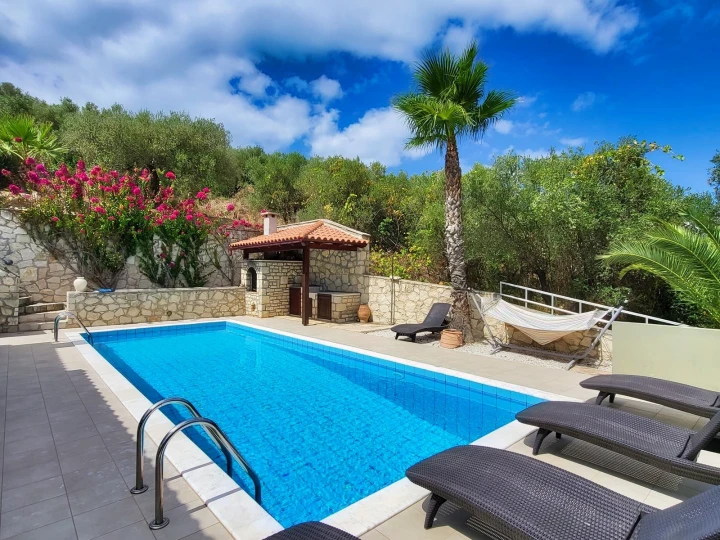
Property values have been rising steadily since 2020. Based on Elxis's own sales records, a newly built villa in the southern part of Rethymno in Crete, at around 80 sq. m. with three bedrooms, two bathrooms, and a pool, has recently been priced at about 327,000 euros. A similar property in the same region sold for around 280,000 euros a year earlier, and for around 265,000 euros in 2022. That works out at an increase of roughly 23.4% over 2022, and about 16.8% year on year.

Interest Rates at Greek Banks as of August 2026 

Each bank sets its own rate, and the final figure depends on your profile, the loan amount, the term, and the property. The figures below are the banks' own published starting rates, checked in August 2026. Rates change often, so treat them as a starting point and confirm the current figure directly with the bank. On top of the rate, every mortgage carries the Law 128/1975 levy, currently 0.12% for a home and 0.60% for a property bought as an investment.


Eurobank runs a dedicated programme for buyers living abroad. You can take a fixed rate starting at 2.90% for 3 years, which then switches to a floating rate linked to the 3-month Euribor plus a spread. You can also fix the rate for the whole term. The published fixed rates (August 2026) for non-Greek and non-Cypriot buyers are:

  • 3 years at 2.90%

  • 5 years at 3.50%

  • 7 years at 3.80%

  • 10 years at 3.90%

  • 15 years at 4.20%


Loans start from 10,000 euros, reach up to 65% of the property's commercial value for non-Greek and non-Cypriot buyers, and run for up to 15 years. There is no penalty for early repayment.


You can find more information on the Eurobank website, here.


Alpha Bank offers a mortgage for foreigners. The fixed rate starts at 2.70% and can be set for 1, 3, 5, 10, 15 or 20 years. The floating option is the 3-month Euribor plus a spread that starts at 1.80%. Loans start from 15,000 euros. You can borrow up to 80% of the commercial value if you live in an EU country, or up to 70% if you live outside the EU. The term runs up to 25 years for EU residents and 20 years for non-EU residents. You need to hold an Alpha Bank account first.


You can find more information on the Alpha Bank website, here.


Piraeus Bank offers fixed rates for 3, 5, 10, 15, 20, 25 or 30 years. The rate can be fixed for the whole term, or for an initial period that then moves to a floating rate on the 1-month Euribor plus a spread. Loans start from 20,000 euros. The exact rate, spread, and lending limit are set when your application is assessed. This looks at factors such as your credit history, the collateral, the loan amount, and the term. As with other banks, non-residents can commonly borrow a smaller share of the property value than local buyers.


You can find more information on the Piraeus Bank website, here.


National Bank of Greece offers fixed, floating, or combined rates, with fixed periods of 3, 5, 10, 15, 20, 25 or 30 years. NBG does not publish a set rate for this profile. It works out your rate individually after reviewing the purpose of the loan, the property value, and your credit score. NBG also commonly asks you to be a Greek tax resident to apply. If you are, the same terms apply as for local borrowers.


You can find more information on the National Bank website, here.


Across all four banks, the borrower's age at loan maturity cannot exceed 75, and early repayment is generally allowed at no cost.

Can I Get a Mortgage for an Off-Plan Home in Greece? 

That’s a question we often receive from our prospects, and it’s really a fair one.


It is generally very difficult, and often not possible, to buy an off-plan home with a standard mortgage. And there is a reason: a mortgage is secured by a lien on an existing, registered property. With an off-plan home, the property does not yet exist, so there is nothing for the bank to hold as collateral until the build is finished and registered. That is why banks are usually reluctant to lend on a home that has not yet been built.


Most off-plan buyers therefore pay in stages instead. The payments are commonly tied to construction milestones and agreed with the developer. At Elxis, our legal team can guide you through how a staged payment plan like this works. 
______________________________________

Disclaimer: This article is intended as general information and does not constitute legal, tax, or financial advice. Rates, lending limits, and requirements vary between banks and can change over time. For guidance on your own situation, please speak with a qualified professional.

You might also like