Short-term rentals in Greece have evolved from a travel trend into a core pillar of the country’s tourism economy. Once seen as a side activity for a few urban hosts, short-term rentals today contribute significantly to national income, support tens of thousands of jobs, and are reshaping how travellers experience the country year-round. You can also explore our full guide on Greek short-term rentals.
Let’s talk with numbers. According to the Greek Sharing Economy Association (SODIA), the sector now adds an estimated €11 billion annually to the Greek economy and supports around 95,000 jobs. What makes this figure remarkable is that most hosts are not large investors but ordinary citizens: families, retirees, and young couples who rent out a home or apartment, often inherited, to supplement their income.
Local Benefits and Community Impact
A study by the Athens University of Economics and Business (AUEB) highlights that short-term rentals generate income that largely stays within local neighbourhoods. Guests spend money at cafés, mini-markets, taxis, cleaning services, and local shops, creating a circle of value that supports small businesses rather than multinational hotel chains.
In many cases, this income helps Greeks maintain or renovate family properties that might otherwise remain empty. Around 80% of hosts own just one or two listings, reinforcing the small-scale, community-based nature of the sector.
SODIA emphasises that short-term rentals complement rather than compete with hotels. Hotel occupancy rates in Greece remain strong, and new properties continue to open, suggesting that both sectors can thrive together. The diversity of accommodation, luxury resorts, boutique hotels, and home rentals has strengthened Greek tourism overall, attracting a wider range of visitors and budgets.
Recent Data Show Steady Growth Beyond the Summer Season
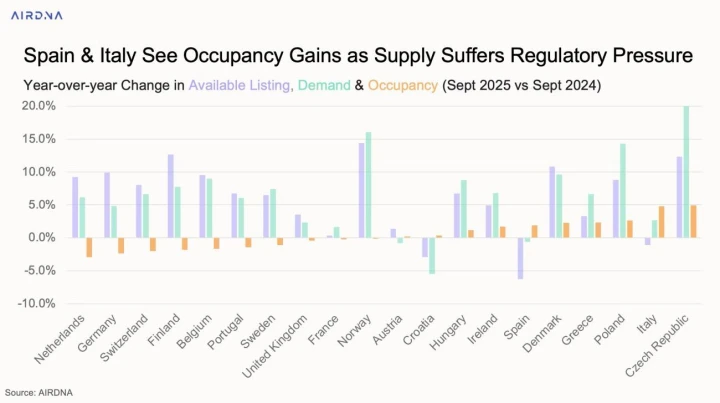
Recent data from analytics firm AirDNA confirm that demand for Greek short-term rentals remains strong even after the summer peak. In September 2025, demand rose by 4.3% year-on-year, while supply increased by 3.9%, showing a balanced and sustainable expansion.

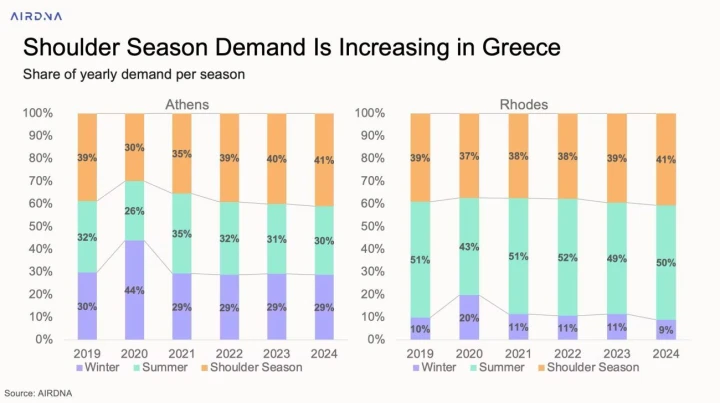
The trend signals a broadening of Greece’s tourism calendar. Visitors are extending their stays into spring and autumn, drawn by mild weather, lower prices, and fewer crowds. For example, in Athens, demand during the “shoulder months” (March–May and September–October) rose from 39% in 2019 to 41% in 2024. Similar growth has been observed in destinations such as Rhodes, where travellers are choosing cooler months over peak-season heatwaves.
While the average daily rate (ADR) dipped slightly to €169 and revenue per available rental (RevPAR) fell to €100, overall occupancy remains healthy at 59%, evidence of a market that is maturing and adapting to year-round tourism rather than relying solely on August’s 76% peak.
Short-term Rentals as A Meaningful Contribution to Greece’s Economy
Economically, short-term rentals now account for roughly one-twentieth of Greece’s Gross Domestic Product (GDP), a striking figure for an activity that barely existed two decades ago. Beyond the €11 billion in direct value, the sector supports a wide network of cleaners, maintenance crews, drivers, and local suppliers, making it one of the most inclusive areas of the tourism industry.
Below are some of the key benefits short-term rentals bring to the Greek economy:
– €11 billion per year (1/20 of GDP): The total contribution of short-term rentals to Greece’s economy.
– Local spending: Every guest supports nearby cafés, shops, taxis, and cleaning services, keeping wealth in the neighbourhood rather than flowing to multinational corporations.
– More than 95,000 jobs: From cleaners and drivers to bakers and technicians, thousands of people rely on short-term rentals for income.
– Complementing hotels: Hotel occupancy rates remain above 90%, with new hotels opening each year, proof that short-term rentals and hotels can coexist and strengthen the tourism ecosystem together.
– Boosting domestic travel: Affordable short-term options allow more Greeks to explore their country with family, making tourism accessible to everyone.
A Sustainable Future for Greek Tourism
The success of short-term rentals mirrors the broader evolution of Greek tourism. The country is moving toward a more diverse, year-round travel model, supported by local hosts and small businesses that keep profits in the community. For international visitors and foreign homeowners, this creates new opportunities, both to experience authentic Greek living and to participate in a market that values local connection, sustainability, and hospitality.