Meraki
This is one of the most incredible words in the Greek language and relates to doing things with passion and with all your heart. It doesn’t have an exact translation in English, but roughly means “the essence of ourselves.” In reality, "meraki" is more closely related to doing something with all your soul, effort, and love. In the context of a villa, it describes the way the home is decorated. In other words, you “put your whole soul” into the decorations.
Galini
Galini has a more straightforward translation, and literally means “calm.” The roots of the word are from ancient Greece, where Galene was one of the fifty Nereids – the so-called sea goddesses. She was depicted as a nymph and was known for her quiet and tranquility, because she could calm the seas. In ancient Greece, it was a common name for girls.
This name might be an ideal choice for a peaceful retreat in Greece.
Kefi
If you’ve ever seen the British-Greek comedy-drama film adaptation of Nikos Kazantzakis’ novel ‘Zorba the Greek’, Zorba is the perfect example of a man with kefi. There is no direct English equivalent. English dictionaries will describe it as a feeling of joy and emotion combined with passion and enthusiasm.
For Greeks, kefi also includes the whole-body and soul experience while dancing and singing. It is a way to handle hardships while also having a carefree moment of bliss. Imagine a scene of Greeks smashing plates at a taverna on a summer night.
Kaloperasi
This word is a poetic way to say “having a good time.” Greeks might say “kaloperasa” with my family during holidays -- “We had a good time” in other words. “Kalo” means “good”, and “perasi” is roughly “the passage of time.” We have a saying in Greek called (I ftohia theli kaloperasi). Essentially, it means you have to make the best of things. Or, translated otherwise: ‘When you’re down, you have to party!’
Parea
What is a parea? A Parea is a group of friends who get together to discuss experiences about their life, philosophies, values, and dreams for the future. It doesn’t have a defined size and can accommodate two, 10, 20, or 50 people. It’s even possible to get asked “Do you want to go parea to a movie?” This roughly translates to “do you want to go together?” Age is not a defining factor – you can have a parea of teenagers, or a parea of retirees.
Greeks have a strong sense of family and togetherness, and “parea” is just one example of how they support one another. In a parea, friends share experiences, grow together, and enrich their lives with shared interactions. The parea is a long-lasting circle and is one reason why the quality of life in Greece is so high.
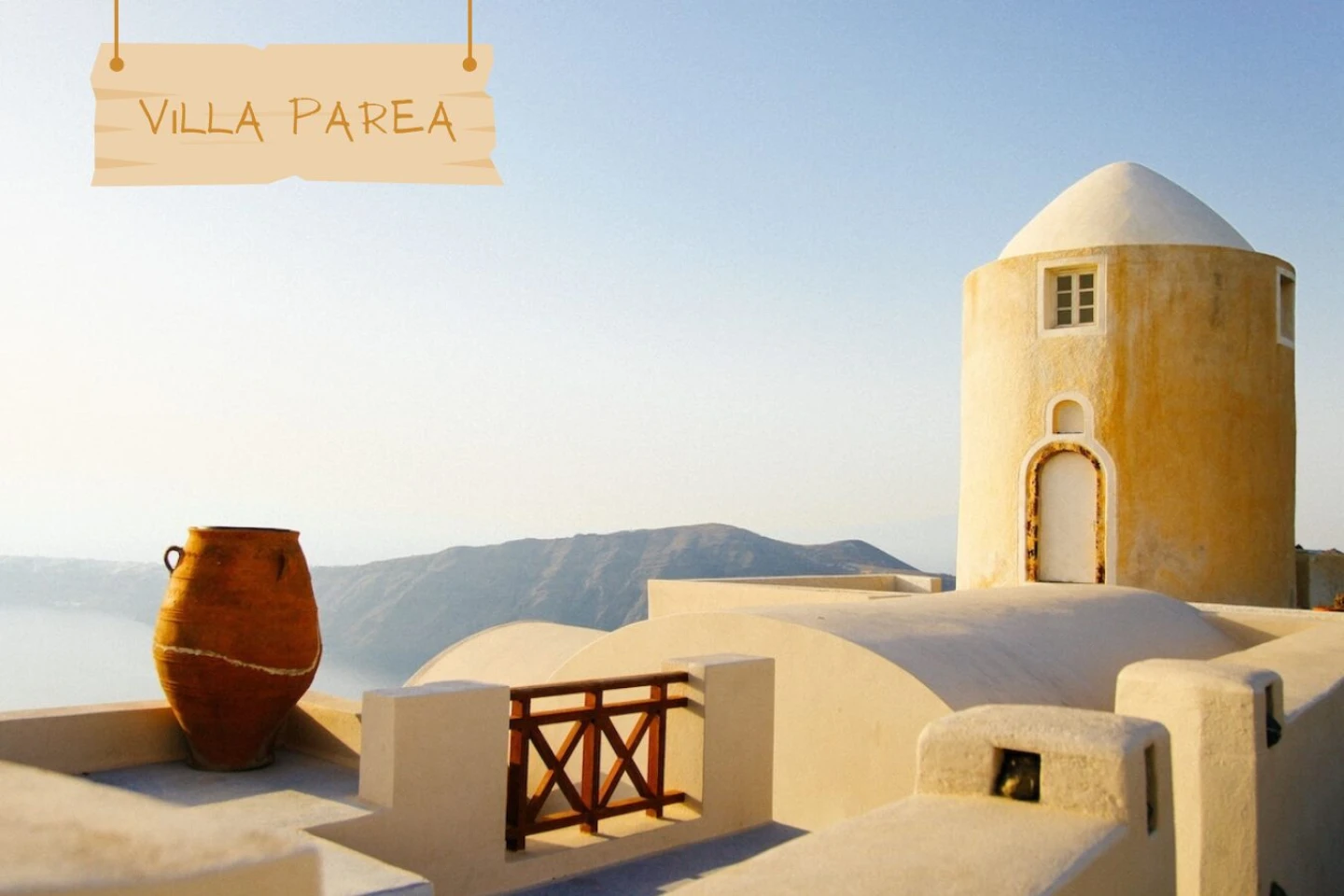
“Villa Parea” may be an appropriate name for your home if you plan to host many guests.

 History & Culture