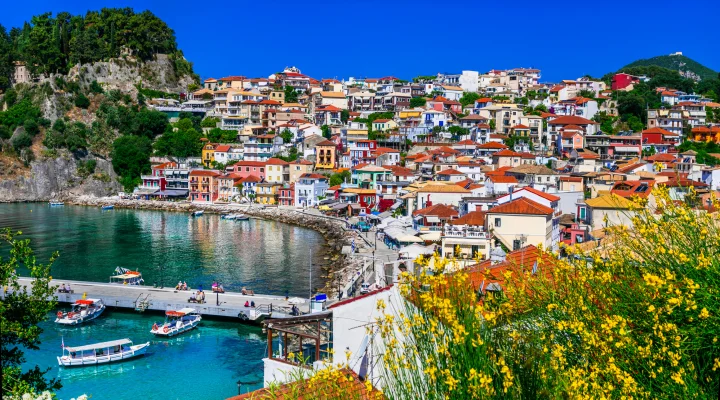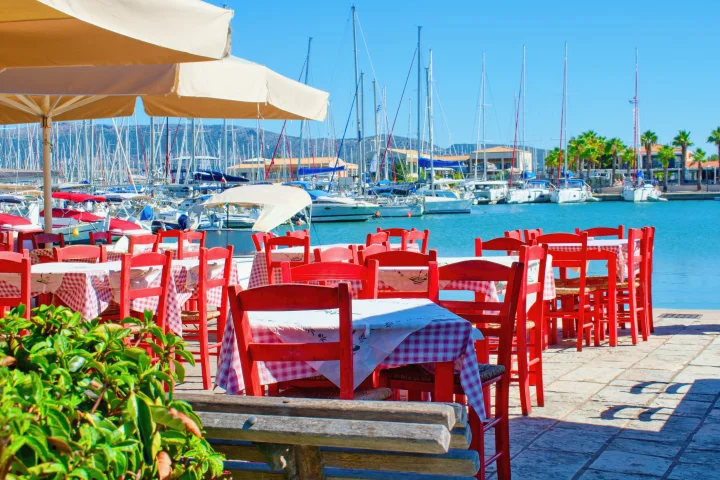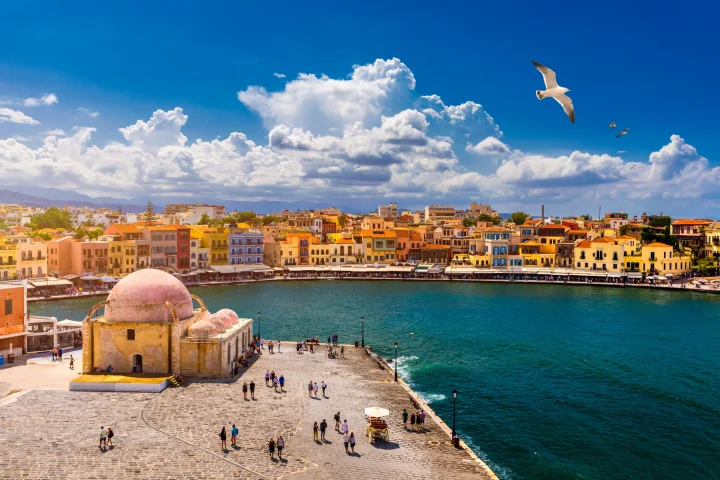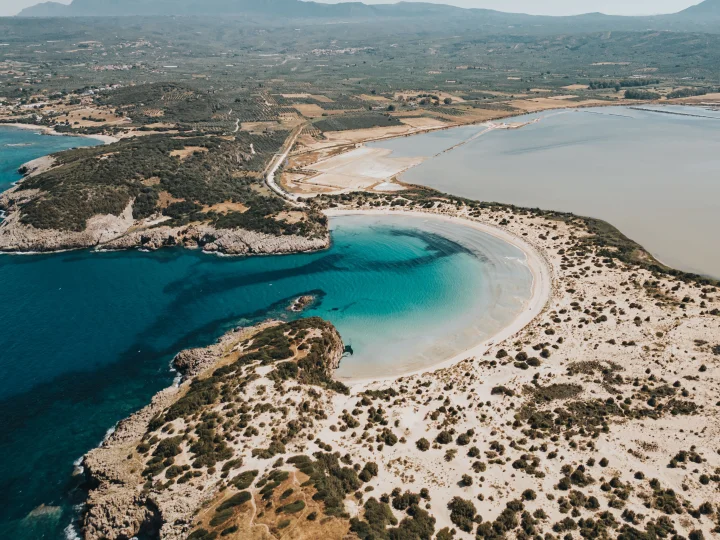

Corfu is a well-known island in Greece, particularly popular as a vacation destination, but it’s much more than that.
The Region of Corfu
Corfu (or “Kerkyra” in Greek) is the northernmost of the main Ionian Islands, covering about 590 square kilometres and stretching roughly 64 km from end to end. As a result, it is the second largest of the Ionian Islands, following Kefalonia.
Since 2019, the regional unit of Corfu has been divided into four municipalities: Central Corfu and Diapontian Islands, North Corfu, South Corfu, and Paxoi. The capital of Corfu is Corfu Town, where you can find shops, banks, public services, pharmacies, and cafes that run throughout the whole year. Then, there is the Ionian University, thanks to which there is a decent student population on the island.
Furthermore, the Old Town of Corfu has been a UNESCO World Heritage Site since 2007.
The History of Corfu
For about four centuries, Corfu was under Venetian rule, and then under French and British rule, before becoming a part of Greece officially in 1864.
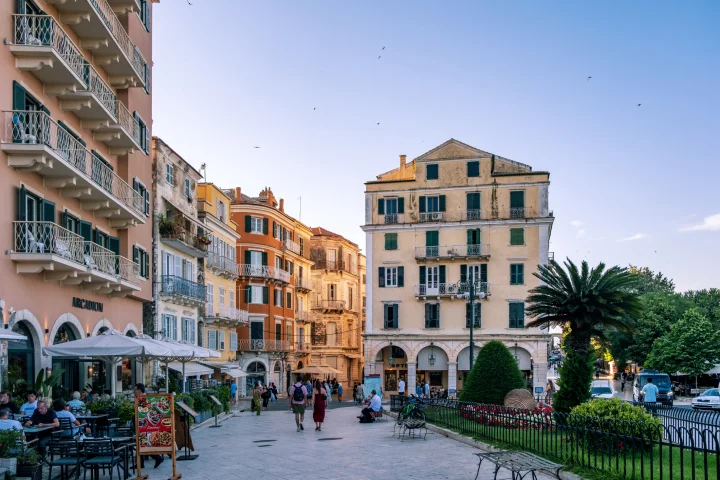
The Liston, for example, the arcaded promenade where locals often meet for coffee, was built by the French between 1807 and 1814, and it was designed by Mathieu de Lesseps, father of the man behind the Suez Canal.
Additionally, the British left a cricket “heritage”, as cricket matches are still played on the Spianada square in the centre of Corfu Town. What is more, Greece’s national cricket federation is based in Corfu.
Apart from cricket, the British left a university, or, to be more precise, the first university of modern Greece, 13 years before the University of Athens. More specifically, in 1824, the British philhellene, Lord Guilford, founded the Ionian Academy in Corfu Town. It closed following the integration of Corfu into Greece, and the current Ionian University can be considered its successor.
Another interesting fact is that in the 17th century, the Venetians paid a subsidy to Corfiots for every hundred olive trees they planted. Today, the island has around four million of them, mostly the tall local Lianolia variety.
Regarding cuisine and taste, the famous pastitsada, sofrito, and bourdeto dishes have Venetian roots, while ginger beer (also known as tsitsibira) arrived with the British.
Every Season Tells A Different Story
One of the greenest places in Greece, Corfu’s charm is visible in every season. Of course, the summer months are the busiest, with many travelers and tourists arriving on the island.
For permanent residents, the best times of the year are mostly spring and autumn, as the weather remains warm, the sea is calm, and the walking trails are at their best, while winters in Corfu are mild but often rainy.
Generally, a morning in town might start with shopping for fresh products from the market below the New Fortress, and then with a cup of coffee under the arches of the Liston (the popular pedestrian street), looking out over the Spianada square.
The afternoons call for lunch and a stroll on the seafront side around Garitsa Bay, while the evenings, as the sun goes down, the small squares and the narrow alleys of the Old Town are calling for exploration and a glass of wine.
Nature and Beaches
Two coasts, creating the feeling of two different islands.
And yes, the west side of Corfu is headed towards the open sea, with long, sandy beaches, like: Agios Georgios, Glyfada, and Issos. It is strongly recommended to watch a sunset from there.
The east, on the other hand, faces the mainland, with calmer seas and pebbled beaches, like: Barbati, Nissaki, and Kalami.
If you head inland, Mount Pantokrator, the highest mountain of the island, rises to 906 in the north-east. Then, in the south-west, the Korission Lagoon often attracts flamingos and many species of birds.
Next, the Corfu Trail, a waymarked walking route, runs the full length of Corfu, and you should definitely include it in your schedule.
Healthcare
The General Hospital of Corfu can be found in the Kontokali region, while there are health centres that serve the wider island. In more special cases, patients may be transferred to the University Hospital of Ioannina (on the mainland).
To do so, you take the ferry to Igoumenitsa from the Port of Corfu, and then you drive for approximately one hour to the hospital.
How Can You Get Around
We have good news: Corfu has its own international airport, called “Ioannis Kapodistrias”, which sits about 2km south of Corfu Town.
Flights to Athens run all year, while the flights to and from international destinations operate mainly from spring to autumn. That said, if you travel to Corfu in winter, you can usually get there through Athens.
By sea, there is a year-round ferry connection between Corfu Town and Igoumenitsa, which makes it easier to connect with the mainland of Greece.
When it comes to the island itself, blue buses serve Corfu Town and nearby villages, while green KTEL buses cover the rest of the island, with fewer routes during winter.
Areas of Corfu For Permanent Living
A general recommendation, if you choose to live in a region of Corfu year-round, is to stay within an hour or an hour and a half from Corfu Town, so that you can benefit from the amenities and the services that function all year long.
Moving forward, Perama, the Achilleion area, and Kompitsi are all about 7 to 10 km from Corfu Town, meaning the hospital, the airport, the port, and many other amenities, are within easy reach. Also, good to note, Perama has its own beaches. In the evening, the viewpoint at Kanoni looks straight down at Mouse Island, with planes gliding in to land just beyond it.
Then, Kato Korakiana, Agios Markos, and Nissaki are about 12 to 22 km from Corfu Town, and they are located right above the beaches of Dassia, Ipsos, and Barbati. From a few hillsides, it is also possible to see across the two fortresses of the Old Town. For a long lunch by the water, the little harbour of Kassiopi and the bay of Kalami, where Lawrence Durrell once lived, are within reach further up the coast.
On the north coast, the main town is called Acharavi, and it offers a bank, post office, pharmacies, supermarkets, and a health care facility. The area’s beach runs for approximately 3km. Moreover, Loutses and Antipernoi are considered to be decent choices. The first one sits in the nearby hills, while the second lies inland towards Roda and Sidari. From Corfu Town, you should expect a 30-40 minute drive.
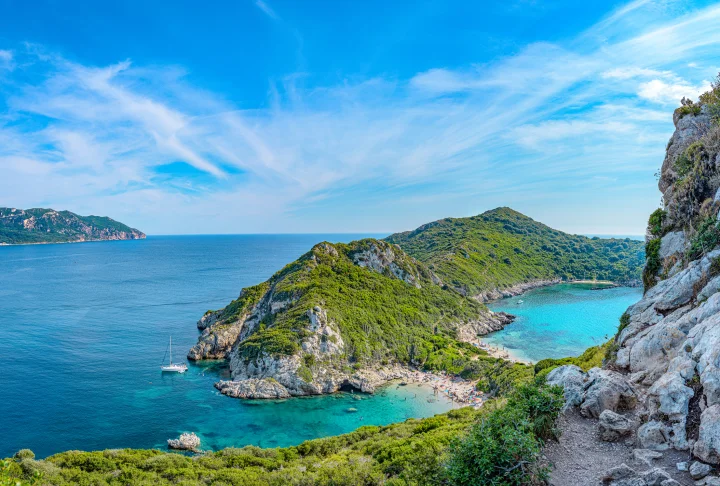
Now, heading to the northwest, also known as the island’s sunset coast, Afionas, Arkadades, and Aspiotades are close to Porto Timoni, Agios Georgios, and Paleokastritsa, three beaches you should include in your list. You should know that few things beat a sunset drink in Afionas, looking down over the twin bays of Porto Timoni.
Lastly, in the south and the southwest of Corfu, Paramonas, Linia, and Dragotina offer long, sandy beaches, as does the already mentioned Korission Lagoon. Again, to get to Corfu Town, it’s approximately a 30-40 minute drive.
Buying a House in Corfu
For more than three decades, we’ve been guiding international property buyers to find their ideal property in Greece. And according to recent findings of ours, the Ionian is one of the most sought-after areas for our clients, following Crete, and the Peloponnese.
So, let us walk you through the nine basic steps to buying a house in Corfu, and in Greece in general.
1. Find the Right Home
Everything starts with the property. You decide on the region, the type of home, and your budget. From there, the search can go two ways. You can browse the properties on our website and see what appeals to you.
You can also share your criteria with us and let our team look on your behalf. Most buyers do a little of both. We then put forward the homes that match, so you are not working through it all on your own.
2. Viewings, Viewings, and Viewings
Once a few properties stand out, visit them in person. Seeing a home for yourself tells you what photos cannot: the feel of the area, the real condition, and what is nearby. This step matters. When you find the one that fits, the next stage is preparing for negotiation.
3. How Much?
Negotiation can feel kind of unpleasant, but it is a normal part of the process, so try not to take it personally. At this phase, a good real estate agent may assist you a lot, as they can often read the market and each property’s value realistically.
4. Legal Due Diligence
This is where a Greek lawyer is needed, as they check the ownership titles and search the local Land Registry to confirm the property is in order and can be sold. Any mortgages, liens, or third-party claims come to light at this stage.
5. Private Purchase Agreement
A Private Purchase Agreement sets out the terms agreed between buyer and seller. Once signed, the property comes off the market, and the buyer pays a deposit to reserve it, typically between 5 and 10% of the price. Now, both parties can start preparing the paperwork for the notary purchase deed.
6. Power of Attorney (POA)
A Power of Attorney lets your lawyer act for you throughout the purchase, even when you are not in Greece. With it, your lawyer can represent you at the tax office for your tax number and sign the final contract, so the purchase process continues while you are abroad.
7. Get a Greek Tax Number (AFM)
You will need a Greek tax number, known as an AFM, to buy. It is issued free of charge on presentation of valid ID and an application form, and it gives you access to the Greek online tax system. Our legal team can fill in the necessary forms on your behalf.
8. Both Parties Sign the Final Deed
The seller provides a set of documents for the notary, including an energy certificate, a civil engineer’s certificate that the property has no building violations, a topographical plan, tax clearance, and municipal certificates.
The notary then prepares the transfer tax declaration. Once the buyer pays the transfer tax, the final deed can be signed. You can attend in person or have your lawyer sign for you under the Power of Attorney.
9. Complete the Payment
In most cases, the buyer pays on the day of signing. Where both banks are in the same country, the funds usually reach the seller the same day. Once payment is received, a discharge deed is signed as proof that the purchase price was paid in full. The exact timing can vary with the circumstances and any terms agreed between the parties. With that, the home is yours.
What Are the Additional Costs?
That’s another question we often receive from our prospects. And a fair one.
As a rule of thumb, the additional costs are approximately 10% on top of the purchase price when it comes to buying a house in Greece. Let’s break these costs down:
Transfer Tax
It is paid by the buyer on existing homes; this is 3.09%* of the purchase price or the taxable value, whichever is higher. New-build properties would normally carry VAT instead, but VAT on new builds is currently suspended, so transfer tax applies in its place.
*Important update: The Greek Prime Minister, Kyriakos Mitsotakis, has announced that the property transfer tax for purchases by non-EU citizens is set to rise to 15%, with the change expected to apply from 2027. The implementing legislation has not yet been published, so the final scope, including how it may treat plots of land and commercial property, is not yet confirmed.
Notary Fees
The notary prepares and oversees the deed. Fees are tiered and work out at around 1-2% of the price, plus VAT.
Land Registry Fees
After signing, the deed is registered locally. These fees come to about 0.5% of the price.
Lawyer's Fees
A lawyer is not strictly required but is strongly recommended to check the legal status of the house you are buying and guide you through the purchase process. Fees typically range from 1 to 2% plus VAT.
Real Estate Agent Fees
This applies where a real estate agent is involved. Elxis charges 3% plus VAT, payable on completion of the purchase.
What Are the Costs of Owning a House
Annual Taxes
ENFIA
ENFIA is the main ongoing tax on your home. It is based on your tax zone, so it is higher in sought-after areas, such as Mykonos, Santorini, and central Athens, and lower in the countryside. For rural properties, it is often around 3 to 4 euros per built square metre per year. A 100 square metre home might pay 300 to 400 euros a year, depending on location. For unbuilt plots, ENFIA is very low.
Rental Tax
If you do not plan to let your home, this section will not apply. If you do, you pay tax on the rental income. For individuals, progressive rates apply, calculated per owner on the gross rental income. Following the changes for 2026, the bands are:
Up to €12,000: 15%
€12,001 to €24,000: 25%
€24,001 to €36,000: 35%
Over €36,000: 45%
TAP (Telos Akinitis Periousias)
TAP is a municipal tax and the smallest of these. It is usually only a few euros and is charged through your electricity bill.
Home Insurance
Greek law does not require home insurance, so it is not mandatory, but it is well worth having. If you own a new development, note that the construction company's insurance has probably expired on the date of delivery. There are insurance agencies throughout Greece, with plans for every budget.
Maintenance of Your Home in Greece
Pool and Garden
Maintaining a pool and garden can cost between 150 and 350 euros a month. This varies with the type of pool and the size of the garden.
Annual Upkeep
Most homes need occasional work over the years, such as painting, polishing, and repairs. In Greece, it is worth repainting pergolas and wooden items exposed to the sun so they keep looking new. Annual upkeep for an average home can range from 1,000 to 4,000 euros a year, depending on the quality of the construction and furniture.
Conclusion
To sum up, Corfu can be a solid option for year-round living, as it combines the island vibe with year-round amenities, and connectivity options not only with the rest of Greece, but with international destinations.
When it comes to picking your next neighbourhood, there is only one way to be certain: a viewing trip to feel the energy of a region, to see what it can offer, and if it aligns with your current lifestyle goals. That should be your first step before signing any papers, as, by doing so, you can really comprehend if there is a place you can imagine yourself calling it "home".