When the time comes to sell your holiday home in Greece, the first real question is what it is worth. Perhaps you are downsizing, simplifying life after retirement, or simply visiting less than you used to.
Whatever the reason, a realistic valuation is what separates a well-priced sale from months of waiting. In Greece, that figure is harder to find than in most of Europe, because sale prices are not public.
No single method gives the full answer. This article sets out a few ways to value a Greek holiday home, what each one can and cannot tell you, and how they work best together.
Why Greece is Different in Terms of Data
In many European countries, you can look up what similar homes sold for. In Greece, you can't. The Hellenic Cadastre records ownership and rights, not sale prices.
Other figures do exist, though none of them shows what a specific home sold for:
The Bank of Greece price index is built on bank valuations. It shows trends, not the value of one property.
Portal indices, such as Spitogatos, track asking prices. The portal itself notes these are usually higher than final prices.
The objective value used by the tax authority (AADE) is a tax baseline, calculated from the zone price of the area and the property's characteristics. The zone prices currently in use date from 2021, and in most popular coastal areas the objective value sits well below the market price.
The objective value still matters when you sell. Taxes on the transfer are generally calculated on whichever is higher, the objective value or the agreed price, and are normally paid by the buyer.
It also helps to know what does not move much. Prices in Greece stay fairly stable through the year. What changes with the seasons is buyer activity, since many buyers combine viewings with a trip, and rental income, which peaks in July and August.
Getting the figure right from the start matters. A price set too high can leave a property on the market for a long time, and repeated price cuts can unsettle buyers. A price set too low leaves money behind.
1: Comparative Market Analysis
A comparative market analysis starts with similar properties that have actually sold, then adjusts for the differences. Because sale prices are not public in Greece, this depends on local knowledge of which homes sold and for how much.
A comparison only works when it is like for like. A house with a sea view is not set against one facing the mountains, and a beachfront villa is not compared with one in the second line. Where no exact match exists, each difference is adjusted for: the distance to the sea, the drive to the airport, the building's age, the pool, the plot, privacy, and road access.
It is also worth checking what the square metres of each property include, since listings do not always measure the same way.
2: Reading Asking Prices With Care
An asking price is the seller's starting point, not the market's final word. Greek asking prices often leave room for negotiation, and how far they sit from realistic sale levels depends on buyer demand and on each owner's own plans.
Buyers from the Netherlands may expect something different. There, the seller usually sets a realistic price and buyers bid above it. In Greece, the movement tends to go the other way.
Time on the market tells you something. A home listed for a long time with little interest may be priced above what buyers are willing to pay, though weak marketing can play a part too. The same property can also appear on several portals at different prices when more than one agent lists it.
New-build and off-plan projects are a useful reference point here. They usually sell at the developer's asking price, so their listed prices sit much closer to what buyers actually pay.
3: Price Per Square Metre
A price per square metre is a quick way to compare, and it needs the same caution. It only means something when the homes are alike: a similar view, distance to the sea, and condition.
Size itself varies. "120 m²" may mean the living space alone, or it may include verandas and basements. Before comparing two figures, it helps to know what each one counts.
4: Rebuild Cost
Another way to check a price is to ask what it would take to recreate the property today. This adds the value of a comparable plot in the same area to the current cost of building a house of the same size and finish.
For an older property, age and wear are taken into account, because a house built twenty years ago is not worth the same as a new one with the same floor plan. The time and effort saved also has a value. Finding a plot, going through planning, and following construction from abroad can take years.
Through our developments team, we work with builders and developers across Greece, so our cost figures reflect current construction prices. The rebuild cost is a check, not a price on its own. A home in a sought-after spot can sell well above it, and one in a less connected area below it. That gap says a lot about how the market values a location.
5: Income Approach
For a holiday home that could be rented out, rental potential offers another check. A simple rule of thumb: the nightly rate in high season is roughly 0.1% of the price.
It is a guideline, not a rental forecast. It quickly shows whether a price makes sense from a rental point of view. Income peaks in July and August, so the rest of the year matters too, as do running costs such as management, maintenance, utilities, and local taxes.
Many holiday home buyers think about rental income, so this check often carries extra weight in a sale.
6: Online Valuation Tools
Online tools, including the automated valuation models used by large property platforms, give a quick first estimate. They are only as good as the data behind them. In Greece, most of the data online is based on asking prices, so these tools work best as a cross-check rather than a final answer.
Accuracy also depends on the details you enter. A sea view, a recent renovation, or the exact condition of a home often only shows in a physical inspection.
7: Formal Valuation by a Certified Valuer
For some purposes, such as a bank loan or a legal matter, a formal valuation report is usually needed. A certified valuer typically inspects the property, reviews its documents, and prepares a detailed report.
This tends to involve documents such as the title deeds, building permits, and records of recent renovations. A formal valuation carries more weight with banks and other parties, and it takes more time than the other methods.
8: A Local Consultant's View
The methods above all need someone to interpret them. Experienced local consultants know which properties sold, which ones draw real interest from buyers, and how a particular street or village compares with the next.
A good valuation comes with its reasoning. Ask how each step was made, and treat the result as the conclusion of several methods, not a single opinion.
What Moves the Value of a Greek Holiday Home
Whichever method you use, the same few factors decide the outcome. In Greece, value is driven by micro-location: the exact spot, not just the region. Three of the four main factors are about location.
The Distance to the Sea
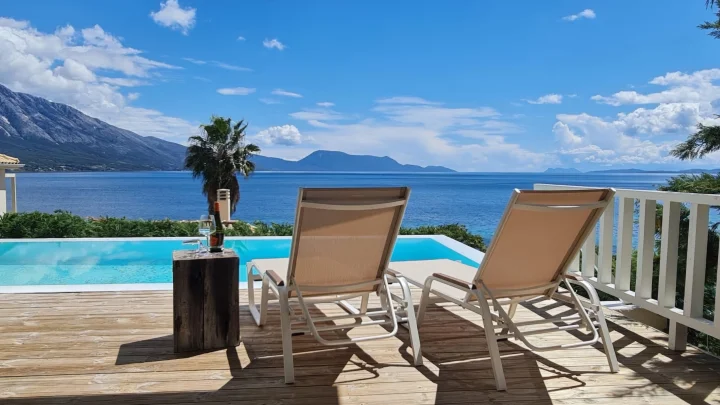
The biggest step in value lies between a beachfront home and the second line. One row of houses can change the price more than you might expect. After that, value falls more gradually, and beyond about a five-minute drive the sea premium has largely gone.
The View
Two neighbouring houses can be the same size, on similar plots, and still be worth very different amounts. Often the difference is simply what you see from the terrace: the sea on one side, the mountains on the other.
The Drive to the Airport
Most holiday home buyers fly in. Up to about 1.5 hours from a well-connected international airport, the effect on value is limited. As the drive approaches two hours, prices tend to drop. On Crete, you can see this when comparing areas near Heraklion or Chania with the less connected parts of the island. On the mainland, Thessaloniki and Kalamata show the same pattern. The number of routes and whether flights run all year count as much as the distance.
The Building
The property type, construction year, floor area, and condition all play a part, as do a pool, the size of the plot, privacy, and road access. For older homes, the state of maintenance weighs heavily. It is also the one factor an owner can influence before a sale, since the location stays as it is.
Choosing the Right Approach for Your Sale
Each method looks at your home from a different angle: what similar homes sold for, what it would cost to recreate, and what it could earn. When they point to the same range, you can price with confidence. When one stands out, it shows where to look more closely.
The right mix depends on why you need the figure. For a bank loan or another formal purpose, a formal valuation is usually needed. If you are exploring a sale, an online estimate followed by a conversation with a local consultant is a sensible start.
Disclaimer: This content is for informational purposes only and does not constitute legal or tax advice. For any issues relating to a specific case, we strongly recommend consulting a lawyer, accountant, or notary, depending on your needs.