UNESCO’s Decision
The head of Greece’s UNESCO delegation in Busan, Georgios Koumoutsakos, hailed the decision as one that would ensure the site’s preservation.
“It reaffirms our unwavering commitment to safeguarding Mount Olympus for the benefit of present and future generations,” he said. “As Greek Mythology wisely reminds us, it is always best to remain on good terms with the gods.”
The region’s mayor, Evangelos Geroliolios, said before the announcement that the site’s induction would “place greater responsibility on our part to protect the [local] environment”, not least its extraordinary biodiversity.
Where is Mount Olympus Located?
Mount Olympus is located in northern Greece, situated along the border between the regions of Thessaly and Macedonia, approximately 80 kilometers (50 miles) southwest of Thessaloniki. Positioned near the eastern coast of the Greek mainland, it overlooks the Thermaic Gulf of the Aegean Sea. Its massive ridge spans the regional units of Pieria and Larissa, with the small town of Litochoro serving as the primary eastern gateway at its base. As the highest mountain in Greece, its tallest peak, Mytikas, reaches an elevation of 2,918 meters (9,570 feet).
What Makes it Significant
Mount Olympus is famous worldwide for connecting past stories with today’s extraordinary natural landscape. In ancient times, the Greeks believed that the twelve Greek Gods and Goddesses, such as Zeus, Hera, Ares, and Aphrodite, resided on the highest peaks of the mountains, from where they ruled the world and made decisions about humans’ future. Those beliefs resulted in the mountain earning a place in the international spotlight. Mount Olympus became the center of famous stories, poems, and artworks that still serve as learning material in schools all over the world.
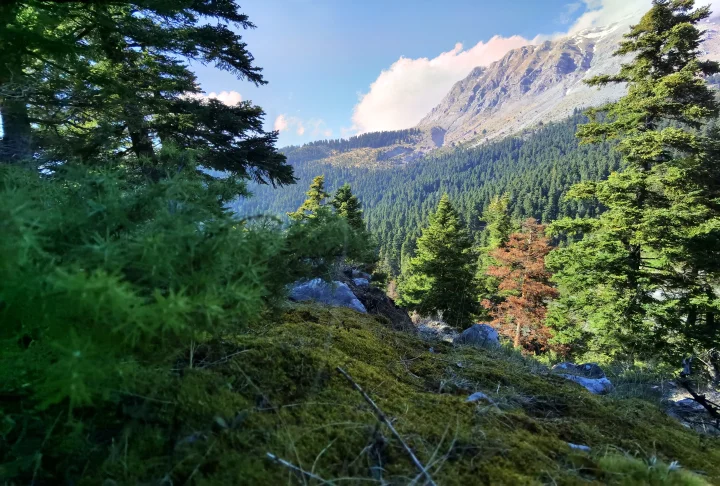
However, Mount Olympus’s significance is not due solely to the stories surrounding it. Its incomparable natural beauty continues to make it a landmark of the utmost importance. It is so special that it became the very first national park in Greece to protect its clean forests, deep canyons, and wild animals. The mountain acts like a giant natural greenhouse, holding nearly 2,000 different types of plants and flowers. This is more than a quarter of all the plant types in the entire country, and many of these special flowers grow on this mountain and nowhere else on Earth.
Also, Olympus is home to the Ancient Sanctuary of Dion, considered the most significant archaeological testament to worship of the Olympian gods. It was the main religious and cultural center of the ancient Macedonian Kingdom. It combines a fortified city grid with a network of surrounding temples dedicated to gods like Zeus, Demeter, and Isis. Alexander the Great famously made sacrifices here before his military campaigns, and the site later grew into a major Roman colony. Today, it is well-known for its unique mix of Greek, Roman, and early Christian ruins, including ancient theaters, large public baths, and a luxury villa with a massive Dionysus mosaic, all preserved within a natural wetland.