Skip to content

Is Chania Old Town Walkable?

Regional Guides

25.09.2025

Chania Old Town

Completely, and that is the point of it. Chania's old town is a knot of pedestrian lanes only a few hundred metres across, pressed between the Venetian harbour and the line of the old city walls. Cars barely enter it; most of it they physically cannot. You can cross the whole quarter on foot in fifteen minutes, and you could spend a week doing so without exhausting the detours. Here is what walking it is actually like, including the parts the brochures gloss over: the cobbles, the luggage problem and where the cars really are.

What Makes the Old Town so Walkable?

It was built for feet. The street plan is Venetian and Ottoman, drawn centuries before cars, and the lanes are too narrow for anything wider than a delivery scooter. The modern city has sensibly left it that way: the harbour front and nearly all the interior lanes are pedestrian, with vehicle access limited to residents and early-morning deliveries on a handful of edges. Distances are small enough that "getting somewhere" is rarely the task. The Municipal Market, the harbour, the lighthouse and the quietest back lanes all sit within a ten-to-fifteen-minute walk of one another. The terrain helps too: the quarter slopes gently down towards the water, with only the low Kastelli hill behind the harbour offering anything you could call a climb.

What is a Walking Route That Actually Works?

Start at the top, at the Municipal Market and the adjacent 1866 Square, and walk down Halidon Street, the old town's main pedestrian artery. On the way down you pass the Orthodox Cathedral on its small square to your right, the Catholic church and the Folklore Museum tucked behind a doorway on the left, and, just before the water, the great Venetian church of St Francis. A note for anyone using an older guidebook: this church housed the Archaeological Museum for decades, but the museum moved in 2022 to a striking new building in Halepa, a pleasant half-hour walk or short drive east of the old town. The collection is worth the trip; just don't look for it on Halidon.


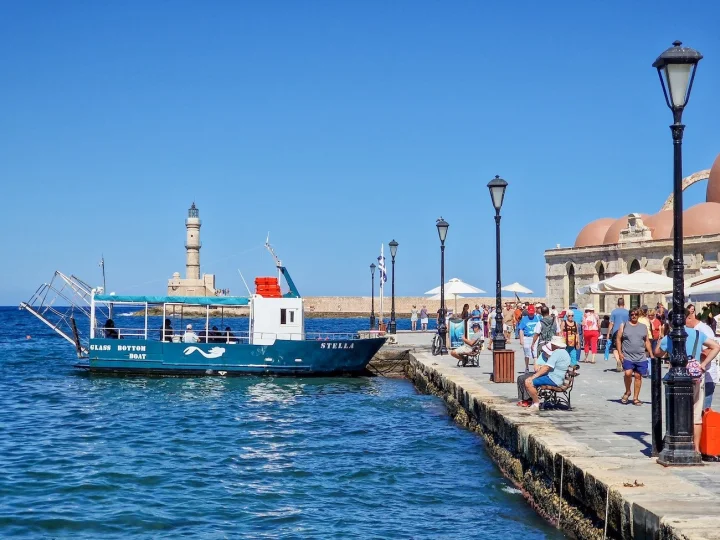
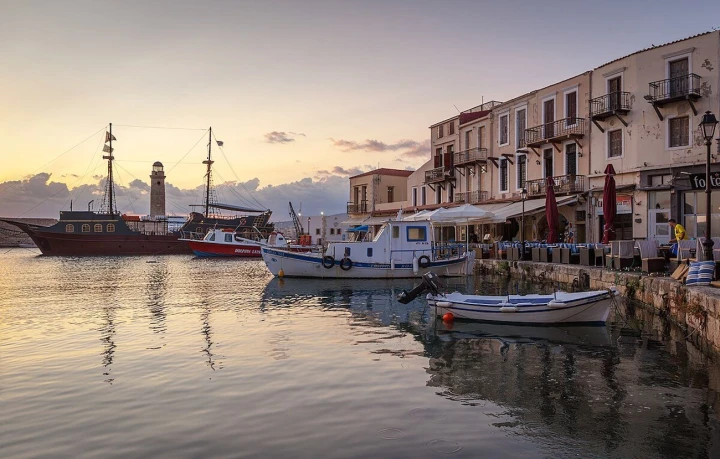
Halidon delivers you to Syntrivani Square (officially Eleftherios Venizelos Square), the small fountain square where the old town meets the harbour and where every walk in Chania seems to begin or end. From here you have the classic choice. Turn left, and the waterfront leads west past the cafes to the Firka Fortress and the Naval Museum, with the best straight-on view of the lighthouse across the harbour mouth. Turn right, and you pass the domed Küçük Hasan Mosque, follow the quay east past the Grand Arsenal and the Neoria, the old Venetian shipyards, and reach the start of the breakwater. The walk out along the mole to the Egyptian Lighthouse and back is about a kilometre and a half of open water views, with no shade and a few uneven stretches, and it is the single best free thing to do in Chania.


For the return, leave the waterfront and come back through the interior. Behind the mosque rises Kastelli hill, the oldest inhabited corner of the city, quiet and residential with Minoan excavations visible between the houses. East of it lies Splantzia, the most local of the old town quarters, built around a plane-shaded square. Or head west instead into Topanas, the old Christian and Jewish quarter around Theotokopoulou Street, where restored Venetian houses, small workshops and courtyard tavernas fill the lanes below the Firka. Topanas and the streets around the fortress are the same neighbourhood, incidentally, whatever some itineraries imply, and it is the prettiest corner of the city in the late afternoon light.

How Long Does a Walk Take?

A first orientation loop, from the market to harbour to Syntrivani and back, takes about thirty minutes at a stroll. Adding the lighthouse breakwater and one interior quarter brings it to around ninety minutes, which is the satisfying version. With museum stops, shopping, a long lunch and the detours the lanes invite, the old town comfortably fills half a day. The better way to experience it, though, is not as a single circuit but in instalments: the harbour and breakwater in the morning before the heat, the shaded interior lanes in the afternoon, Topanas and the waterfront again at sunset. The quarter is small enough that returning costs nothing.

How Hard Are the Cobbles Really?

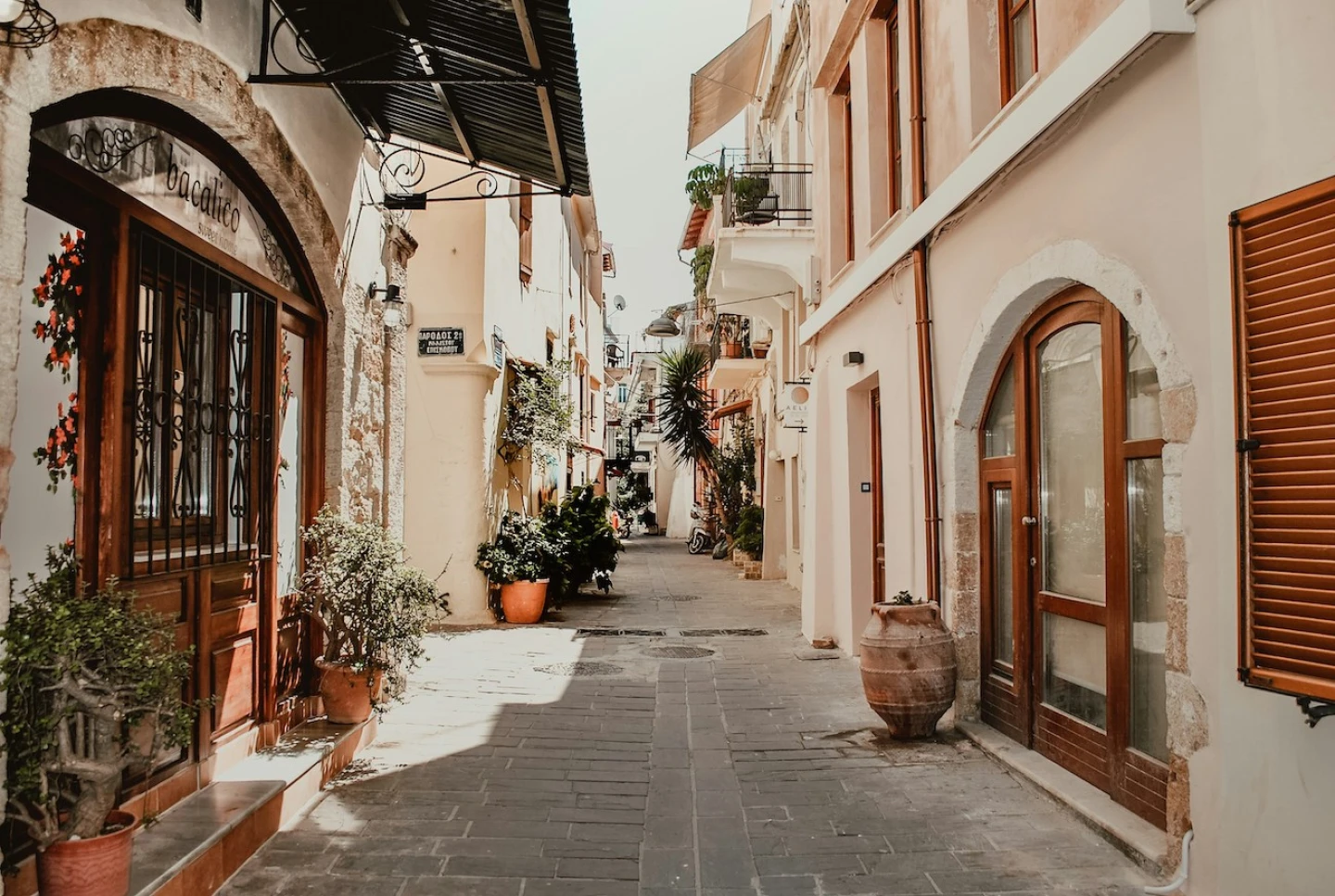
Honest answer: noticeable but manageable. The waterfront promenade and Halidon are smooth and well maintained, fine for prams, wheelchairs and anyone steady on their feet. The side lanes are older and rougher, with uneven stones, the occasional step and gaps that catch a heel. After rain, or during the morning wash-down, the polished stones turn slippery. For visitors with limited mobility, the realistic guidance is this: the harbour front, Halidon and the main connecting streets are accessible and cover most of the headline sights; the narrowest interior alleys and parts of Kastelli involve steps and rough surfaces that wheelchairs will find difficult. The slopes themselves are gentle almost everywhere.


The one group the old town genuinely punishes is arriving guests with wheeled suitcases. Most old town accommodation cannot be reached by car, so the last few hundred metres are a cobblestone drag from the nearest drop-off point. Pack accordingly, confirm the walking distance with your hotel, and consider it a one-time toll for sleeping inside a Venetian monument.

Where Do You Still Meet Cars?

Mainly at the edges. The perimeter roads, Skalidi and Chatzimichali Giannari along the southern boundary and the streets east of the old harbour, carry normal city traffic, and that is where taxis drop you. A few boundary streets allow residents' vehicles and morning deliveries, so the occasional slow-moving car or scooter does appear in the outer lanes. Inside the core, including Halidon and the harbour front, you are sharing space with pedestrians, cafe tables and cats, not traffic.

What Should You Wear?

Flat, comfortable shoes with decent grip: trainers, walking sandals with a proper sole, anything you would happily stand in for three hours. Heels and smooth leather soles are genuinely a bad idea on polished stone. Hiking boots are overkill for a flat seaside town; this is cobbles, not a gorge. In summer, the interior lanes provide good shade, but the harbour front and the breakwater have none, so a hat, sunglasses and water belong in the bag for the middle of the day. In winter and after rain, soles with grip matter more than waterproofing.

Seeking a House in Crete?

Contact us!

You might also like