About the Data in this Article
The figures here are based on Greece's most recent census, conducted in 2021, with results published in 2022. You may never have heard of some of the islands on this list. On a map, you might not even spot them. But many are among Greece's most beautiful places, known for their nature, quiet towns, and clear-water beaches.
North Aegean
Samothrace, around 2,500 residents
Samothrace, or Samothraki, is one of Greece's harder islands to reach, and is known for its nature. It is said to be where Alexander the Great was conceived. It is a paradise for nature lovers, with 500-year-old chestnut trees, some with trunks at least two metres wide. It is also one of the longest continuously inhabited islands in Greece. It was a religious centre in ancient times, and at Therma you can find hot mineral springs.
Fournoi, around 1,300 residents
Fournoi is a small island chain in the North Aegean, near Ikaria and Samos. Its people are mostly beekeepers and fishermen. Kampos, the main village, is known for its tavernas and bakeries (fournoi means "ovens" in Greek). The local favourite is the island's orange soda.
Oinousses, around 900 residents
Oinousses is a group of nine small islands, including Oinoussa, Panagia, and Gaidouronisi. They are very quiet, with little nightlife and plenty of room to relax. They are part of Greece's protected Natura 2000 network, with one main road curving around and connecting the beaches.
Ionian Islands
Paxos, around 2,300 residents
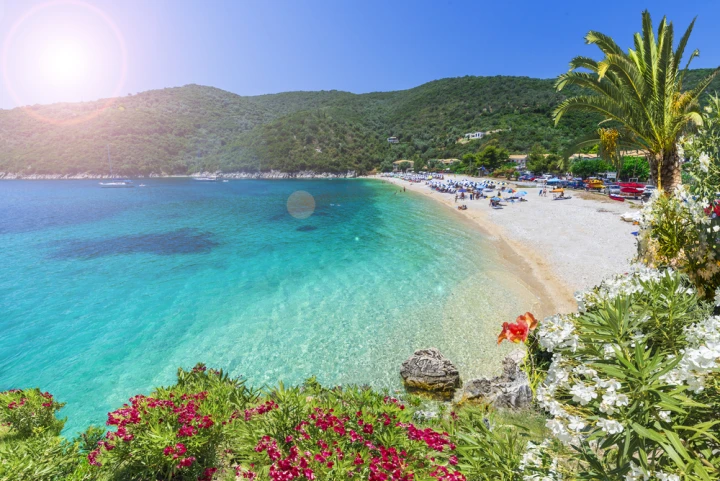
Paxos is one of the smallest islands in the Ionian chain, west of the mainland. The nearest island is Corfu, about 50 kilometres away, reached by a quick ferry. Part of the island's charm is that it has no airport. It is known for its clear waters, beaches, and vineyards, and its economy is mostly tourism, olive oil, and fishing.
Ithaki, around 2,800 residents
Ithaki is another small island in the Ionian chain. Its history goes back 6,000 years, and it is famous as the home of Odysseus, the hero of Homer's Odyssey. The capital is Vathi, and around the island you will find picturesque villages. Few people live here today.
Meganisi, around 1,000 residents
Meganisi is a tiny island close to the mainland, just east of Lefkada and about 2 kilometres from Skorpios, the island once owned by Aristotle Onassis. Its best-known village is Katomeri. There are many pleasant beaches, good for watersports, and the Papanikolis cave is worth seeing.
Argo-Saronic Islands
Hydra, around 2,100 residents
Hydra is close to Athens, only about an hour away by ferry. It is car-free: transport is mainly by mule and water taxi, which has helped it keep its character and quiet. Hydra is a protected traditional settlement under Greek law, with its mansions, heritage, and nature carefully preserved. The town is built like an amphitheatre. Just to either side of the port are the parapets and cannons that once protected it, and the statue of the Hydriot warrior Andreas Miaoulis stands at the left of the port.
Agistri, around 1,130 residents
Agistri is probably the least-known island in the Saronic chain. It is ideal for families, with a pine forest and shallow waters. Popular beaches include Chalikiada, Dragonera, and Skala. It is a relaxed spot for couples and families alike.
Dodecanese
Astypalaia, around 1,300 residents
Astypalaia is the westernmost island in the Dodecanese, with a long history, villages of beautiful white houses, sunny beaches, and dramatic views from its castle. Its shape is unusual: a narrow strip of land joins the two halves, so from above it looks like a butterfly. The western part is Mesa Nisi and the eastern part Exo Nisi. Τhe main town is Chora. Its most imposing monument is the 13th-century Venetian Querini Castle. The three-storey houses built on the castle's outer grounds are unusual, as their walls double as the castle wall and their narrow windows once served as battlements.
Nisyros, around 1,040 residents
Nisyros is a scenic island in the Dodecanese. Its secluded location makes it a good alternative destination. Its most famous sight is its volcano, in the centre of the island, one of several active volcanoes in Greece, along with Santorini.
Symi, around 2,600 residents
Symi, sometimes spelled Simi, lies next to Rhodes. It is a hidden gem of the Dodecanese, with colourful houses, and the port looks like a postcard as you approach by boat. The capital is split into two parts, Gialos and Chorio. Other highlights include the Panormitis Monastery and the island's beaches.
Tilos, around 750 residents
Not to be confused with Tinos, Tilos is in the Dodecanese and forms part of an ecological park and nature reserve. It is known for its 400 species of flora and fauna and 150 species of birds. It rarely appears on the usual tourist trail, but many say it is just as beautiful as the famous islands.
Chalki, around 330 residents
Chalki sits in the Dodecanese, very close to Rhodes, and has not yet been touched by mass tourism, which makes it a great choice for a quiet holiday. Its solar grid was the first of its kind in Greece, intended to power the whole island. It is among the smallest islands in the Dodecanese, with a total area of about 28 square kilometres.
Kasos, around 1,200 residents
Kasos is the southernmost island in the Dodecanese, with a natural charm of its own. It is quieter than its neighbours, with peaceful beaches, pretty villages, local feasts, and traditional Greek cooking. Local customs, and the Easter celebrations in particular, are very much alive here.