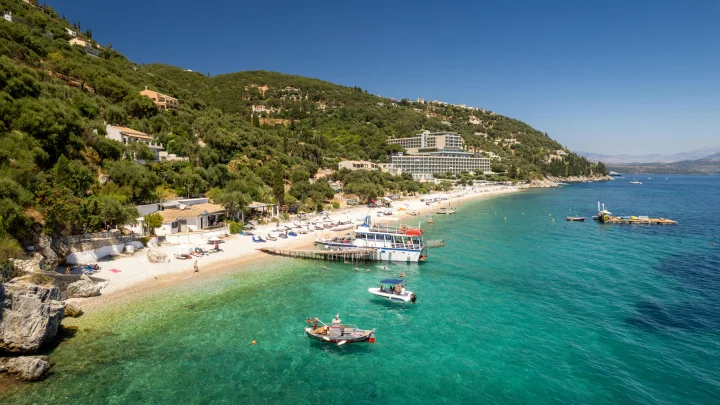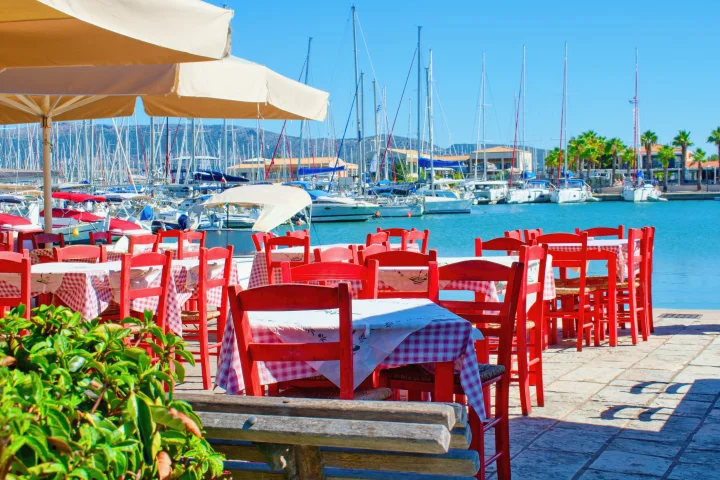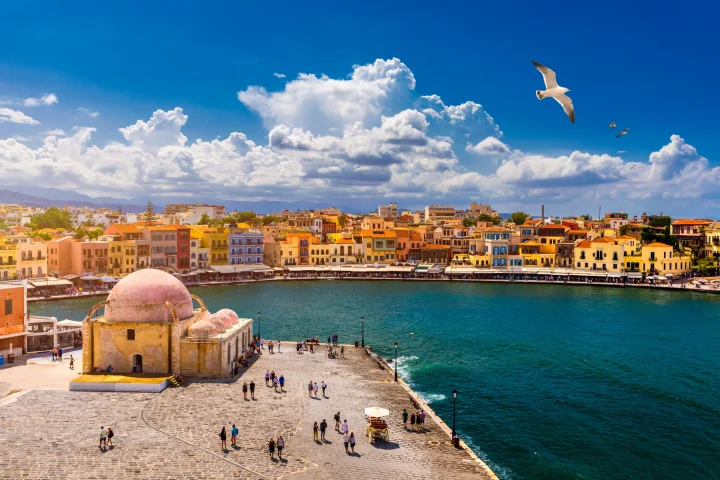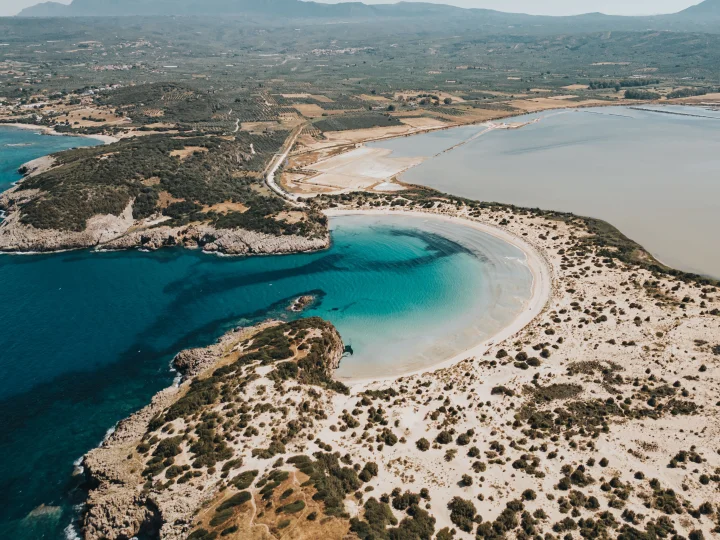
The first thing that probably comes to your mind when you hear the words “Ionian Sea” is its islands. On the mainland side, though, there are a few regions that can be considered a practical and smart choice for international property buyers.
Let’s see what daily life looks like when it comes to permanent living.
The Basics of Daily Life on the Ionian Coast
To begin with the geography, most of this coastline belongs to the region of Epirus. Its northern part, including Igoumenitsa, Sivota, and Perdika, lies in the regional unit of Thesprotia, while Parga and Preveza, two areas with strong potential in terms of real estate, belong to the regional unit of Preveza.
To talk numbers, in 2021, the municipality of Preveza had around 31,000 permanent residents, while the municipality of Parga had around 11,000. For many property buyers, the fact that these towns are small is, in fact, part of their appeal.
In other words, by picking these areas, you get all the shops and the everyday amenities you may need, without the hustle and bustle of a big city.
A Coast Shaped by History
What is probably not widely known is that the Ionian Coast has changed hands many times, and it is still visible in the architectural approach.
For a quick trip back in time, you can find the ruins of Nikopolis (also known as the “City of Victory”), about 8 km north of Preveza. It was founded by Octavian after defeating Mark Antony and Cleopatra in the naval battle of Actium in 31 BC. Today, the site is included on Greece’s tentative list for UNESCO World Heritage status, and its archaeological museum opened in 2009.
Parga, on the other hand, has a history of its own: in 1401, its inhabitants signed a treaty that placed the town under the protection of the Venetians, and, therefore, it served as a Venetian outpost for four centuries.
In 1819, Parga was handed over to Ali Pasha of Ioannina, and most of its inhabitants left for Corfu, to avoid living under his rule.
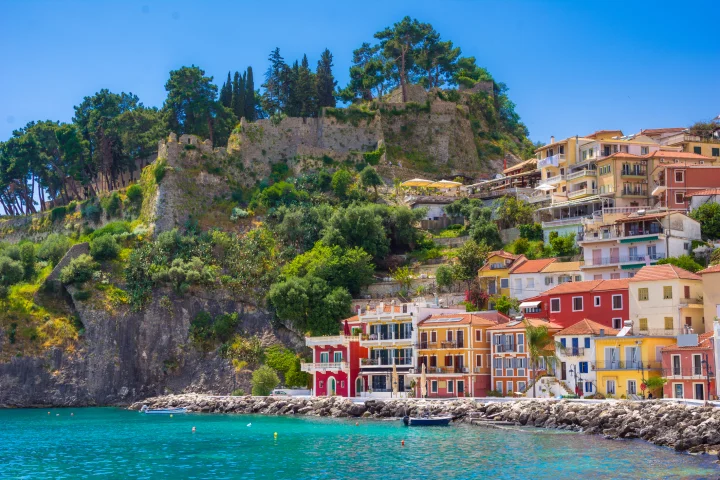
The castle’s present form dates mainly back to the Venetian period, and the citadel at the top, with an inscription from 1820, was added by Ali Pasha.
How Each Season Feels on the Ionian Coast
The climate is generally mild, with warm summers (especially during July and August) and gentle but wet winters.
While the summer is the busiest period of the year, when the beaches and the tavernas are at their busiest, locals and residents mostly vote for spring and autumn to be the best time of the year, as the region becomes green, the weather is warm, and you can easily enjoy a peaceful hike with a view.
It’s good to keep in mind that during winter, some hotels and beach bars in the resort villages close following the end of the summer season. However, Preveza and Igoumenitsa keep running year-round, with many shops, cafes, banks, pharmacies, mini markets, and public services to cover your daily needs.
Beaches, Nature, Healthcare Facilities, and Getting Around
As you head to the south of the Ionian Coast, there is a notable diversity to what is offered. For example, around Sivota and Parga, you can find small coves, wooded hills, and small islets. What is more, between Parga and Preveza, there is a long sandy shoreline, from Mytikas to Kastrosykia, with Monolithi being its best-known beach.
Then, the Amvrakikos Gulf lies east of Preveza, with lagoons and river deltas from the Amvrakikos Wetlands National Park, which was established in 2008, and it’s where about 300 bird species have been recorded.
Now, in the resort towns, which attract more tourists and travelers, you can easily communicate in English in your everyday life, but for public services or other official processes, you might need some assistance from locals who speak Greek.
When it comes to healthcare, Preveza has a General Hospital, while health centres serve the wider regional unit at the same time.
On special occasions, residents may need to travel to Ioannina, where the University Hospital is located. To get there by car, it’s approximately a drive of an hour and a half. There are also KTEL bus connections between these two cities.
Sticking to transportation and connectivity, Aktion National Airport, only a short drive away from Preveza through the undersea tunnel across the mouth of the gulf, offers international flights to many European cities, mainly from May to October.
In winter, those who fly from other countries usually land in Athens first, and continue by domestic flight, where available, or by road.
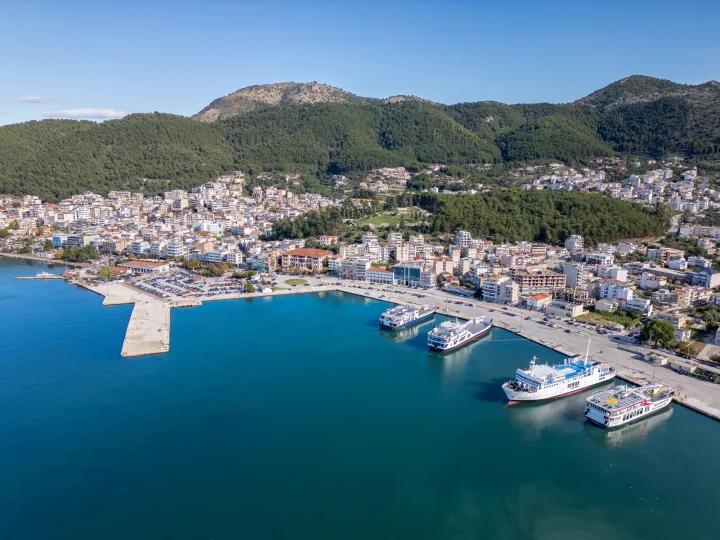
The port of Igoumenitsa is a decent asset of this region, as it offers ferry connections to Corfu, Paxos, and the Italian ports of Ancona, Bari, and Venice; the frequency and the routes depend widely on the season.
Areas for Permanent Living on the Ionian Coast
Let’s start with Preveza, as it provides a mix of advantages for year-round living. First of all, it has a hospital, many shops, schools, a marina, and public services, while being the closest town to Aktion Airport. Next, Kanali, which is located north of Preveza, is a quieter and less developed region compared to Parga, so it can be a good choice for a peaceful retreat, with the city being only a short drive away.
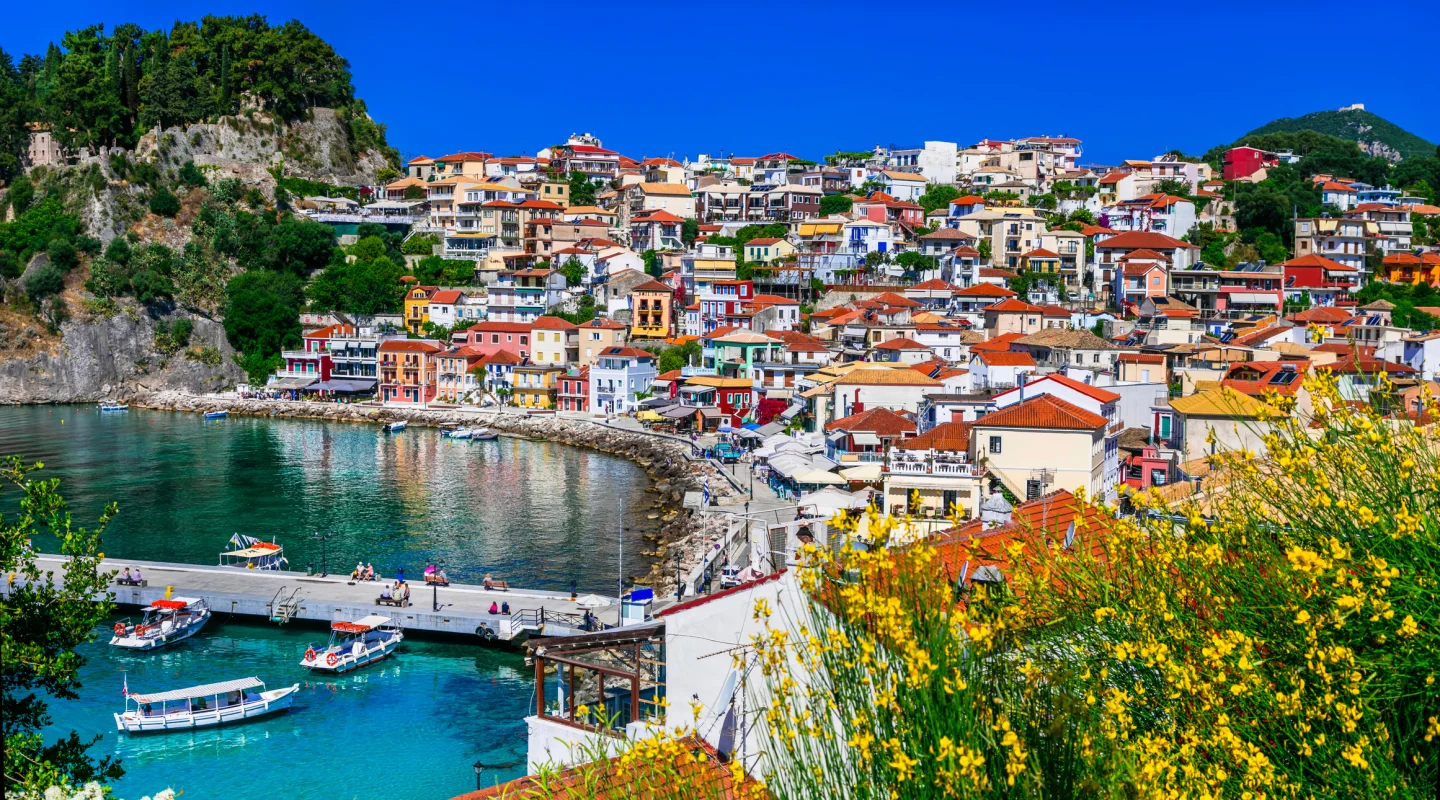
Parga (often called the “Bride of Epirus”) is a coastal town that really feels like an authentic Ionian Island, thanks to its amphitheatrical, colorful buildings and its smooth maritime vibe. Its Venetian castle overlooks the small harbour, so it’s definitely recommended to wander around for a quick trip back in time and to catch a sunset.
If you keep heading further north, there is Sivota (or Syvota), a coastal resort and former fishing village that sits tucked inside a bay. Its marina acts basically as the beating heart of the region, featuring waterfront tavernas, cocktail bars, etc. It is an ideal spot for a sunset stroll or a romantic evening.
Only a short drive away from Preveza, you can get to Paleros and Pogonia, two more authentic destinations, offering a slow pace of life, combined with a modern touch.
For example, the marina of Paleros serves as a major base for yacht charters who wish to explore the Ionian Sea. Also, through this harbour, it is possible to get access to the quiet islands of Kalamos, Kastos, and Meganisi, which are all within reach by boat.
Pogonia is an authentic coastal village that is divided into two sections, based on the lifestyle provided: the lower seaside, including the harbour, is more tourist-oriented, with tavernas, and luxury holiday villas.
The upper village, on the other hand, is where the traditional houses of the permanent residents can be found. It’s a landscape full of olive trees, cypress trees, and wild oregano.
As we tend to say at Elxis, the right location for you mainly depends on what you seek in terms of lifestyle. If you are planning to buy a house on the Ionian Coast for permanent living, we would recommend staying close to year-round services, so that your daily needs are covered.
Buying a House on the Ionian Coast
For more than three decades, we’ve been guiding international property buyers to find their ideal property in Greece. And according to recent findings of ours, Ionian is one of the most sought-after areas for our clients, following Crete, and the Peloponnese.
So, let us walk you through the nine basic steps to buying a house in this area, and in Greece in general.
1. Find the Right Home
Everything starts with the property. You decide on the region, the type of home, and your budget. From there, the search can go two ways. You can browse the properties on our website and see what appeals to you.
You can also share your criteria with us and let our team look on your behalf. Most buyers do a little of both. We then put forward the homes that match, so you are not working through it all on your own.
2. Viewings, Viewings, and Viewings
Once a few properties stand out, visit them in person. Seeing a home for yourself tells you what photos cannot: the feel of the area, the real condition, and what is nearby. This step matters. When you find the one that fits, the next stage is preparing for negotiation.
3. How Much?
Negotiation can feel kind of unpleasant, but it is a normal part of the process, so try not to take it personally. At this phase, a good real estate agent may assist you a lot, as they can often read the market and each property’s value realistically.
4. Legal Due Diligence
This is where a Greek lawyer is needed, as they check the ownership titles and search the local Land Registry to confirm the property is in order and can be sold. Any mortgages, liens, or third-party claims come to light at this stage.
5. Private Purchase Agreement
A Private Purchase Agreement sets out the terms agreed between buyer and seller. Once signed, the property comes off the market, and the buyer pays a deposit to reserve it, typically between 5 and 10% of the price. Now, both parties can start preparing the paperwork for the notary purchase deed.
6. Power of Attorney (POA)
A Power of Attorney lets your lawyer act for you throughout the purchase, even when you are not in Greece. With it, your lawyer can represent you at the tax office for your tax number and sign the final contract, so the purchase process continues while you are abroad.
7. Get a Greek Tax Number (AFM)
You will need a Greek tax number, known as an AFM, to buy. It is issued free of charge on presentation of valid ID and an application form, and it gives you access to the Greek online tax system. Our legal team can fill in the necessary forms on your behalf.
8. Both Parties Sign the Final Deed
The seller provides a set of documents for the notary, including an energy certificate, a civil engineer’s certificate that the property has no building violations, a topographical plan, tax clearance, and municipal certificates.
The notary then prepares the transfer tax declaration. Once the buyer pays the transfer tax, the final deed can be signed. You can attend in person or have your lawyer sign for you under the Power of Attorney.
9. Complete the Payment
In most cases, the buyer pays on the day of signing. Where both banks are in the same country, the funds usually reach the seller the same day. Once payment is received, a discharge deed is signed as proof that the purchase price was paid in full. The exact timing can vary with the circumstances and any terms agreed between the parties. With that, the home is yours.
What Are the Additional Costs?
That’s another question we often receive from our prospects. And a fair one.
As a rule of thumb, the additional costs are approximately 10% on top of the purchase price when it comes to buying a house in Greece. Let’s break these costs down:
Transfer Tax
It is paid by the buyer on existing homes; this is 3.09%* of the purchase price or the taxable value, whichever is higher. New-build properties would normally carry VAT instead, but VAT on new builds is currently suspended, so transfer tax applies in its place.
*Important update: The Greek Prime Minister, Kyriakos Mitsotakis, has announced that the property transfer tax for purchases by non-EU citizens is set to rise to 15%, with the change expected to apply from 2027. The implementing legislation has not yet been published, so the final scope, including how it may treat plots of land and commercial property, is not yet confirmed.
Notary Fees
The notary prepares and oversees the deed. Fees are tiered and work out at around 1-2% of the price, plus VAT.
Land Registry Fees
After signing, the deed is registered locally. These fees come to about 0.5% of the price.
Lawyer's Fees
A lawyer is not strictly required but is strongly recommended to check the legal status of the house you are buying and guide you through the purchase process. Fees typically range from 1 to 2% plus VAT.
Real Estate Agent Fees
This applies where a real estate agent is involved. Elxis charges 3% plus VAT, payable on completion of the purchase.
What Are the Costs of Owning a House
Annual Taxes
ENFIA
ENFIA is the main ongoing tax on your home. It is based on your tax zone, so it is higher in sought-after areas, such as Mykonos, Santorini, and central Athens, and lower in the countryside. For rural properties, it is often around 3 to 4 euros per built square metre per year. A 100 square metre home might pay 300 to 400 euros a year, depending on location. For unbuilt plots, ENFIA is very low.
Rental Tax
If you do not plan to let your home, this section will not apply. If you do, you pay tax on the rental income. For individuals, progressive rates apply, calculated per owner on the gross rental income. Following the changes for 2026, the bands are:
Up to €12,000: 15%
€12,001 to €24,000: 25%
€24,001 to €36,000: 35%
Over €36,000: 45%
TAP (Telos Akinitis Periousias)
TAP is a municipal tax and the smallest of these. It is usually only a few euros and is charged through your electricity bill.
Home Insurance
Greek law does not require home insurance, so it is not mandatory, but it is well worth having. If you own a new development, note that the construction company's insurance has probably expired on the date of delivery. There are insurance agencies throughout Greece, with plans for every budget.
Maintenance of Your Home in Greece
Pool and Garden
Maintaining a pool and garden can cost between 150 and 350 euros a month. This varies with the type of pool and the size of the garden.
Annual Upkeep
Most homes need occasional work over the years, such as painting, polishing, and repairs. In Greece, it is worth repainting pergolas and wooden items exposed to the sun so they keep looking new. Annual upkeep for an average home can range from 1,000 to 4,000 euros a year, depending on the quality of the construction and furniture.
Conclusion
As also mentioned above, the Ionian Coast of the mainland can offer the island vibe with practical advantages, like the connectivity of a road connection and the proximity of the airport near Preveza.
Then, it’s up to you to decide if you are after a more lively town, such as Preveza, a coastal village like Sivota, or a quieter retreat near Kanali.
The best way to start this journey is to plan a viewing trip, so that you can determine if a certain place feels like home, before you proceed with any paperwork. Because when we talk about permanent living, you should be able to contemplate your life somewhere if you wish to find a property to call “home”.