
20.10.2026
The Most Famous Homes in Greece
There are some houses in Greece that gain fame because of the people who lived in them, such as writers and musicians, or even... a king!
History & Culture
24.02.2025
Let’s be real – who doesn’t like marble?
It adds a touch of luxury to any home and is durable, so it doesn’t wear down over time. Like a good Greek wine, it can even look better with age. Marble also comes from nature, so no two pieces are alike, and it brings a natural feel to your home that a man-made product can’t duplicate. In Greece, marble has been used for over two thousand years in both its UNESCO monuments and in Greek homes. Because Greece has such great sources of marble, it continues to be used today. In this article, we explore the incredible types of marble in Greece from then and now.
One of the best marbles for art historically in Greece is Parian marble. It is a pure white and flawless marble that was first used in the classical era on the island of Paros. The ancient Greeks used it for sculptures like Venus de Milo, Hermes and the Infant Dionysus, for theParthenon’s roof, and later for Napoleon’s tomb. It can also be found in Delos, Delphi, Athens, and Olympia in public buildings. One of the biggest mines in Paros was called the “Quarry of the Nymphs,” which produced 100,000 cubic meters of marble in the past. Slaves used to work there under lamplight.
Pentelic marble is also a flawless white stone that looks slightly golden under the sun. It is found at Mount Penteli, which is not far from Athens. If you look at the mountain today from Athens, you can see “wounds” from all the quarries there. Pentelic marble was used as long ago as 570 BC, and it was used in the Older Parthenon in 450 BC. It became the primary material for the Acropolis’s buildings and in the statues of the surrounding area. When the Romans ruled Greece, Julius Caesar also used it in the new Roman Agora. In the 2nd century, Pentelic marble was used in the Temple of Olympian Zeus as well as the Panathenaic Stadium (Kallimarmaro), which was such a large project that it used up almost all of the available supply.
By the time the Romans were using Greek marble, they weren’t happy with only white marble. They wanted multicolored marble, which was available in some areas of Greece. For example, they imported green and red marble from the Peloponnese, grey marble from Evia, and black marble from Chios. Green marble could also be found in Skyros and Tinos, and Thasos has a nice white marble that is close in quality to Pentelic. Below is an example from K-Studio in a home in Mykonos, where floors, bathrooms, and bedroom tables were constructed with Greek marble.
Some of the most beautiful dark yellow marble is found near Thebes, in the Elikonas mountain. Here, back in the Middle Ages, the area was known for its stone mansions, some of which are still standing today. The marble from Thebes has been used in many contemporary pieces of art and even for the decoration of the John F. Kennedy memorial.
Mining marble is different than it was in ancient times. In ancient times, mostly only hand tools were used, and the work had very little error. The craftsmen and sculptors said that their work was a gift to the gods, and the masters knew how to pick the best marble. They usually got the marble from mountain sites and then brought it to the worksite with different ropes, cranes, carts, and rollers.
The island of Tinos in the Cyclades has always been known for its marble works. Back in the 1950s, craftsmen from Tinos were hired to reconstruct the Stoa of Attalos. Later in the 1970s, they were called on to work on the Erechtheion in Athens. Today, traditional workers from Tinos are doing restorations on the Parthenon. A local legend says that Tinos’s locals were taught by Phidias himself, a famous sculptor from the 5th century BC. We don’t know if this is true, but Tinos’s sculptors definitely were a part of the making of the Academy of Athens, the Athens Concert Hall and the National Library.
One town is Tinos is especially for its marble: Pyrgos. It is the largest village on the island and has 1000 residents. Some people call it “an open-air marble museum.” Marble is found all over the town, both in public buildings and in homes, door lintels, and fountains. A number of local craftsmen sell marble artwork in their showrooms.
Greece still has many areas with high-quality marble. It is a big part of the economy. Julie Haidas, CEO of marble suppliers Iktinos, says that "Marble is in the top 10 exports of Greek products, and that's because our focus is to export it.” She says that for every euro the marble industry produces, it contributes about 2.20 euros to the economy, more than double. “We like to say that marble is one of the best products we export to the world." In fact, Greece exports over 75% of the marble it harvests. Below is an example from K-studio in a home in the Peloponnese, where floors, bathrooms, and counters were constructed with Greek marble.
20.10.2026
There are some houses in Greece that gain fame because of the people who lived in them, such as writers and musicians, or even... a king!
05.10.2026
In his poem, "Days of Kindness", from 1985, Leonard Cohen describes Greece as being a good place to read by moonlight on the terrace. He knew this from experience. Hydra was his home for much of the 1960s. He arrived in the spring of 1960, aged 25, and later bought a house on the island, where he wrote much of his early work. Many places on Hydra still carry traces of him, even now that Hydra has become far better known.
16.04.2026
Greece is often associated with ancient history, island landscapes, and carefully preserved traditions. Less discussed, however, is another layer of its identity: its place names. Across the mainland and the islands, thousands of villages carry names that can sound unexpectedly funny or strikingly literal to a modern Greek speaker. These are not recent inventions or deliberate attempts at humor. Most date back centuries, shaped by geography, daily life, local dialects, and historical circumstances. What makes them stand out today is the shift in language over time. Words that once served as straightforward descriptions of land, resources, or communities can now feel unusually direct or unexpectedly humorous. Looking at these names more closely offers insight into how earlier generations observed their surroundings and chose to define them.
20.03.2026
Greece has long been more than a travel destination. For centuries, writers have been drawn to its history, natural beauty, and authenticity, finding in Greece not just a setting, but a source of inspiration that shapes narratives, characters, and perspectives.
19.02.2026
02.01.2026
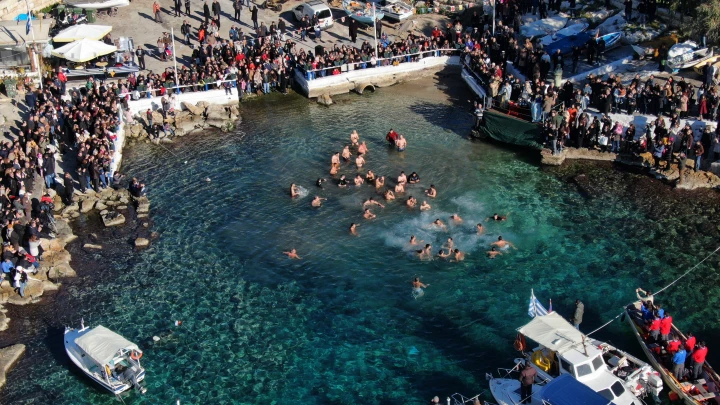
In Greece, the holiday season does not end on New Year’s Day. Instead, it culminates in one of the most symbolic celebrations of the year: Epiphany, known in Greek as Theofania. More than a religious holiday, Epiphany in Greece represents the triumph of light over darkness, a spiritual “new beginning” for individuals and communities. For anyone living in Greece, or dreaming of owning a home here, Epiphany offers one of the most authentic snapshots of local culture. From the blessing of the waters to ancient folk rituals, this day reveals the deep connection between the Greek people, nature, and tradition.
30.12.2025
Crete is stepping into the global spotlight once again. According to Airbnb’s latest travel trend insights based on worldwide search data from Q3 2025, the island — and especially the iconic Samaria Gorge National Park — ranks among the most sought-after nature destinations for 2026. This surge reflects a broader shift in how people choose where to travel, live, and invest. Travellers are no longer looking only for beaches or city breaks. Instead, they are drawn to authentic natural environments, outdoor experiences, and destinations that offer both beauty and balance, qualities that Crete delivers effortlessly.
19.12.2025
Greece is known mostly for its pristine beaches and its endless summers. Also, Greek cuisine, with its unique Mediterranean dishes, is widely sought after. What might feel surprising is the magical beauty during Christmas in Greece. The country has a long festive season that runs from Christmas to Epiphany (the “Φώτα” on 6 January), full of local customs, food traditions, and small village rituals that still matter to people today. Winter destinations are also famous in Greece, as according to the latest Monitoring Sentiment for Intra-European Travel report (Wave 23) by the European Travel Commission (ETC), Greece ranks among the top 10 most desired European destinations for travel between October 2025 and March 2026, holding a solid 7th place.