
20.10.2026
The Most Famous Homes in Greece
There are some houses in Greece that gain fame because of the people who lived in them, such as writers and musicians, or even... a king!
History & Culture
07.01.2025
Where Do Greek towns get their names? Why does it feel like every town I pass in Greece starts with “Agios”? Why is Mykonos called Mykonos? And why is Santorini called Santorini? In ancient Greece, did Greek islands have the same name as they do today? All your questions about the names of islands and towns in Greece are answered in this article.
The data shared in this article comes from the Hellenic Statistical Authority, as well as data analysis by data scientistJaime Garcia Chaparra. 12,904 settlements in Greece are included in the calculations.
You’re not crazy; Greece really does reuse town names. Out of almost 13,000 towns and villages in Greece, about 4,000 are repeated names. So, about 40% of location names are used more than once in Greece. The 50 most common town names make up almost one in ten towns in Greece. Some of the most common names of towns and villages in Greece are Agios Georgios, Agios Nikolaos, Agios Dimitrios, Neochori, and Kallithea.
“Agios” in Greece means “Saint”. In Greece, 670 places start with this word, because Greece has many Orthodox Christians. In Mykonos, almost 15% of towns are named after a saint.
Yes, some Greek town names are specific to certain islands because of naming traditions. For example, on the island of Kefalonia in the Ionian Sea, almost half of the island’s towns end in the letters “a-t-a”. This ending for town names is almost never found in other areas of Greece. Similarly, in Crete, a large group of towns in west and central Crete end in “es”. Kalyves, Fres, and Kerames are just a few examples. Towns ending in -ovo are mostly found in the Epirus region in Northwestern Greece. For example, Metsovo, Kapesovo, and Tsepelovo fall into this category.
In the Greek language, towns, like any other nouns, can be either masculine, feminine, or neutral. Some towns are even plural. The largest percentage of towns in Greece are given a feminine gender. The longest one-word name for a town in Greece isΣταματογιανναίικα (Stamatogiannaiíka) in Aetolia. If you count, that’s 17 letters.
If you drive through Greece, you will probably come across “old” or “new” versions of the same town. “Paleo” means old and “neo” means new. The largest number of these towns are in Macedonia and Thrace. There are also several in the Peloponnese. For example, Epidavros in the Peloponnese has both an "ancient Epidavros" and a "new Epidavros" town. To add to this, the famous theater of Epidavros isn't located in the ancient town, but in a separate location. Be sure to set your navigation to the correct destination, or you could get lost!
The name of this famous Greek island comes from the first ruler of the island, whose name was Mykonos. He was said to be a descendant of Anius, the mythical king of Delos. Delos island is located across from Mykonos and is a popular day trip from Mykonos.
Korkyra or Kerkyra was the name in antiquity. In the Medieval and Byzantine era (since the 7th century), the island name was changed to Korypho. The name “Koryphó” (Κορυφώ) “peak”, refers to the peaks of the fortified Byzantine acropolis (today the Old Fortress). This same name is found in all texts from Medieval and Byzantine times. Luitprand, Bishop of northern Italy in Cremona, once returned to Italy from his embassy to Constantinople and he stopped at Corfu, which he called by the name Coriphvs (=Κορυφούς=Κορυφώ=English Corfu). This suggests that the name was already in use in the year 968 and characterized the whole island. The same name in the West prevailed as “Corfu,” and it spread internationally.
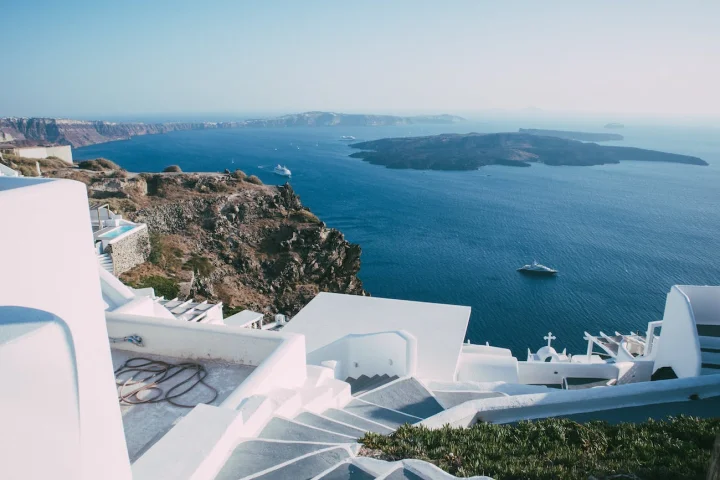
The name of this famous Greek island comes from the Frankish Crusaders who stopped on the island for supplies, likely in the 13th century. Reports tell that they stopped near the church of Saint Irene, and the name of the island followed. As you can see in the image below, not much of Saint Irene's Church is still standing. On some maps, Santorini will go by the name “Thira”, which translates to “door” or “gate”. The name “Thira” comes from the ancient Spartan Theras, who was the first person to bring settlers to the island.
Since ancient times, the island of Rhodes has been associated with the rose flower. The connection with the rose comes from the ancient Greek god Helios, who considered roses to be sacred. Although it's not obvious when you make a visit to Rhodes nowadays, the island used to have a unique connection to Helios. The Colossus of Rhodes, one of the wonders of the ancient world, depicted the sun god. This is why coins from Rhodes on one side had the head of Helios, and on the other side, a rose.
The name of Athens is rooted in mythology. As the story goes, the Greek gods wanted to name the city after either Athena or Poseidon. As a gift offering, Athena offered an olive tree, which is supposedly still standing on the Acropolis hill. The olive tree was thought to be useful because it offers oxygen, shade, food, olive oil, and wood. In contrast, Poseidon offered a saltwater lake, which naturally was not as useful to the inhabitants, so Athena won the city. As you walk up the Acropolis Hill and get close to the Propylaea gateway, you will find the small temple of Athena Nike.
20.10.2026
There are some houses in Greece that gain fame because of the people who lived in them, such as writers and musicians, or even... a king!
05.10.2026
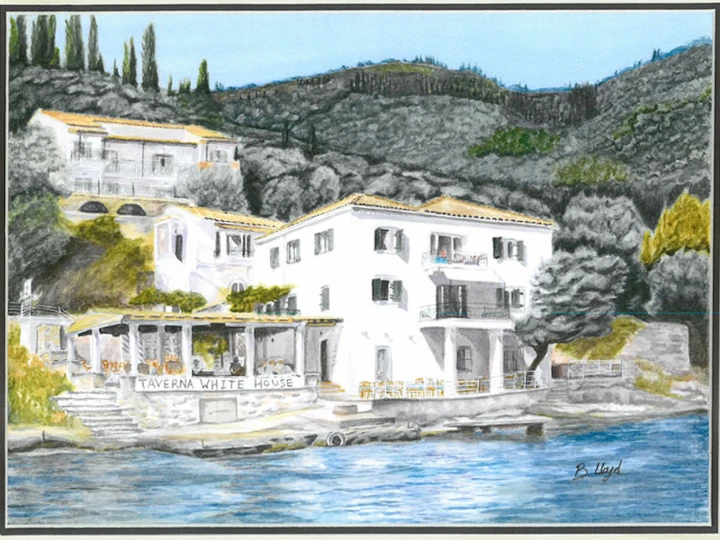
In his poem, "Days of Kindness", from 1985, Leonard Cohen describes Greece as being a good place to read by moonlight on the terrace. He knew this from experience. Hydra was his home for much of the 1960s. He arrived in the spring of 1960, aged 25, and later bought a house on the island, where he wrote much of his early work. Many places on Hydra still carry traces of him, even now that Hydra has become far better known.
16.04.2026
Greece is often associated with ancient history, island landscapes, and carefully preserved traditions. Less discussed, however, is another layer of its identity: its place names. Across the mainland and the islands, thousands of villages carry names that can sound unexpectedly funny or strikingly literal to a modern Greek speaker. These are not recent inventions or deliberate attempts at humor. Most date back centuries, shaped by geography, daily life, local dialects, and historical circumstances. What makes them stand out today is the shift in language over time. Words that once served as straightforward descriptions of land, resources, or communities can now feel unusually direct or unexpectedly humorous. Looking at these names more closely offers insight into how earlier generations observed their surroundings and chose to define them.
20.03.2026
Greece has long been more than a travel destination. For centuries, writers have been drawn to its history, natural beauty, and authenticity, finding in Greece not just a setting, but a source of inspiration that shapes narratives, characters, and perspectives.
19.02.2026
02.01.2026
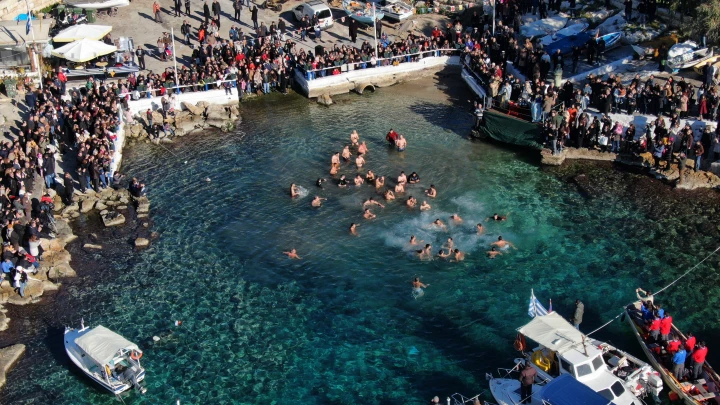
In Greece, the holiday season does not end on New Year’s Day. Instead, it culminates in one of the most symbolic celebrations of the year: Epiphany, known in Greek as Theofania. More than a religious holiday, Epiphany in Greece represents the triumph of light over darkness, a spiritual “new beginning” for individuals and communities. For anyone living in Greece, or dreaming of owning a home here, Epiphany offers one of the most authentic snapshots of local culture. From the blessing of the waters to ancient folk rituals, this day reveals the deep connection between the Greek people, nature, and tradition.
30.12.2025
Crete is stepping into the global spotlight once again. According to Airbnb’s latest travel trend insights based on worldwide search data from Q3 2025, the island — and especially the iconic Samaria Gorge National Park — ranks among the most sought-after nature destinations for 2026. This surge reflects a broader shift in how people choose where to travel, live, and invest. Travellers are no longer looking only for beaches or city breaks. Instead, they are drawn to authentic natural environments, outdoor experiences, and destinations that offer both beauty and balance, qualities that Crete delivers effortlessly.
19.12.2025
Greece is known mostly for its pristine beaches and its endless summers. Also, Greek cuisine, with its unique Mediterranean dishes, is widely sought after. What might feel surprising is the magical beauty during Christmas in Greece. The country has a long festive season that runs from Christmas to Epiphany (the “Φώτα” on 6 January), full of local customs, food traditions, and small village rituals that still matter to people today. Winter destinations are also famous in Greece, as according to the latest Monitoring Sentiment for Intra-European Travel report (Wave 23) by the European Travel Commission (ETC), Greece ranks among the top 10 most desired European destinations for travel between October 2025 and March 2026, holding a solid 7th place.